
























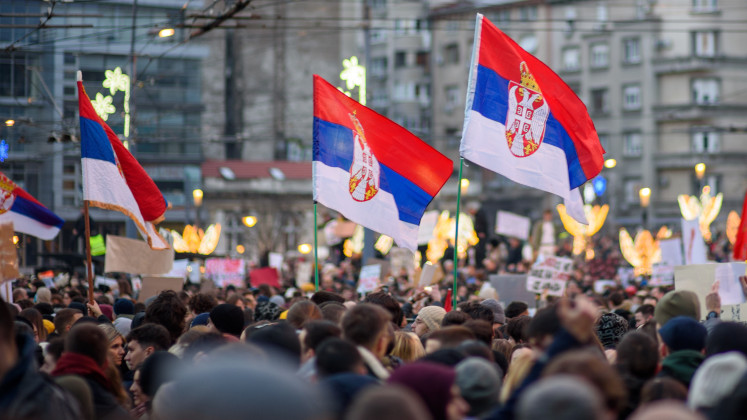
Serbia’s student-led protests have developed into a sustained challenge to the authority of Aleksandar Vučić’s government. Jelena Filipovic writes that as the protests have intensified across 2025, consumer choices have increasingly become a vehicle for expressing solidarity.
In Serbia, where media capture, electoral irregularities, and police violence have weakened traditional avenues of dissent, an unexpected form of resistance has taken root: the “buycott”. While political boycotts – refusing to engage with companies linked to government interests – are a familiar tactic, citizens are increasingly doing the opposite. They are deliberately targeting their spending on businesses that align with civic values and express solidarity with the ongoing Serbian student protests.
This behaviour is not coordinated by political parties or NGOs. It emerges informally through social media, local networks and everyday transactions. What may appear to be routine consumer choices are functioning as accessible, low-risk expressions of political alignment – especially in a context where open protest carries a reputational or professional cost.
Civic expression through consumption
In academic terms, buycotting is a subset of political consumerism, defined as “market-based actions taken by individuals with the intention of making a political or ethical statement through their consumption choices”. This concept has been widely applied in studies of affluent democracies, but is now gaining traction in research on semi-authoritarian settings. In Serbia, where institutional responsiveness is limited, buycotting offers an alternative outlet for political engagement – operating at the intersection of market behaviour and civic identity.
The rise of buycotting in Serbia follows months of protests sparked by allegations of electoral fraud, government pressure on media and aggressive policing. What began as student-led mobilisation in early 2025 has evolved into one of the most sustained civic movements in the country’s post-Milošević era. While demonstrations and meetings remain visible, citizens are increasingly engaging in less formalised responses – particularly through consumption.
One notable example occurred in July 2025 in Valjevo, where a locally owned café called Corner was vandalised after its owner expressed support for the protests. In response, residents queued for hours to buy coffee – an act widely interpreted as a demonstration of solidarity. In cities such as Niš and Novi Sad, social media users have compiled lists of businesses that supported the protests by closing during strikes or sharing public endorsements. Consumers are encouraged to reward these businesses through ongoing loyalty.
Serbia thus illustrates the relevance of political consumerism in semi-authoritarian contexts. Citizens are not primarily motivated by ideological purity, but by the relative accessibility of market decisions in an environment where institutional levers are increasingly ineffective.
Buying as resistance
Buycotts allow individuals to express political preferences without engaging in more visible or confrontational forms of protest. But Serbia’s buycotting behaviour also reflects broader trends in values-based consumption.
When independent news channels were dropped by telecom providers like Yettel and Orion, many customers cancelled their subscriptions and switched to SBB, which retained access. Meanwhile, Laguna, Serbia’s largest bookstore chain, publicly backed student protests and was met with a surge in consumer loyalty. These cases illustrate how reputational credibility and civic alignment increasingly shape purchasing behaviour.
Academic literature provides additional context. Buycotting can be understood as a form of market-mediated identity signalling – enabling individuals to express alignment with social norms or political communities through consumption. Research in consumer psychology indicates that even seemingly spontaneous decisions are often underpinned by moral reasoning and social coordination. Consumers are not only rewarding perceived integrity but also reinforcing their own values within peer networks.
This distinction between boycotting and buycotting is particularly relevant in Serbia. While boycotts are typically framed as punitive, buycotts affirm identity and reinforce normative cohesion. They offer a constructive outlet for civic participation at a time when elections, media and institutional checks are widely perceived as compromised.
Buycotting also tends to be more effective in competitive markets. Georgy Egorov and Bard Harstad have shown that consumer activism has the greatest impact when switching costs are low and reputational stakes are high. Many of the Serbian cases – telecoms, cafés, bookstores – fit this profile. In such environments, even small shifts in loyalty can influence business decisions and public narratives.
Serbia’s buycotts also align with patterns observed among Gen Z consumers, whose purchasing decisions are often shaped by political identity and lifestyle alignment. This demographic uses consumption as a tool for community affiliation and ethical signalling, reinforcing the idea that market choices can function as socially embedded forms of civic engagement.
The EU’s credibility gap
These developments raise broader questions for the European Union. Serbia remains a candidate country for EU accession, yet the trajectory of democratic reform is widely viewed as regressive. While negotiations continue at the formal level, there is growing scepticism among Serbian civil society about the EU’s commitment to democratic standards.
The emergence of buycotting as a form of civic engagement highlights how citizens are adapting to institutional stagnation by exercising agency through alternative channels. In doing so, they reveal a normative commitment to democratic values, even if this is expressed outside conventional political arenas.
This gap is evident in the annual reports from the European Commission’s Directorate-General for Neighbourhood and Enlargement Negotiations (DG NEAR), which offer detailed assessments of Serbia’s legal and institutional alignment with the EU acquis. Considerable attention is devoted to areas such as financial regulation, digital assets and consumer protection, yet informal civic behaviour receives no recognition. Enlargement policy remains largely focused on top-down benchmarks, with limited engagement with grassroots expressions of democratic resilience.
Enlargement Commissioner Marta Kos recently emphasised that Serbian protesters are demanding much the same reforms that the EU requires for accession, adding that “every government should consider what its citizens are saying”. These remarks affirm that citizen-led actions like buycotting reflect EU normative priorities. The absence of such behaviour from institutional reporting highlights a disconnect between formal policy frameworks and emergent civic agency.
Rather than treating such behaviour as anecdotal, EU institutions should consider it an indicator of bottom-up resilience. Civic values persist in constrained environments and consumer behaviour is one way that alignment with liberal democratic norms is quietly sustained. Recognising this dynamic may help rebuild the EU’s credibility among the very constituencies it claims to support.
The civic meaning of everyday choices
Serbia’s buycotts are decentralised and improvised but analytically coherent. They represent a form of political participation that gains salience when conventional channels are obstructed. Consumers are using everyday decisions to reward perceived civic alignment, demonstrate social belonging, and express dissatisfaction, albeit through indirect means.
For EU policymakers, this presents both a challenge and an opportunity. On the one hand, it reflects the limits of formal engagement mechanisms. On the other, it offers insight into the adaptive capacities of democratic actors operating in constrained settings.
Democracy is not only shaped by institutions or protests – it is also enacted in the patterns of consumption that express values and signal allegiance. As citizens turn to the marketplace to assert civic values, EU actors face a choice: whether to acknowledge and support these informal expressions of democratic agency or continue prioritising regime stability at the cost of local credibility.
Note: This article gives the views of the author, not the position of EUROPP – European Politics and Policy or the London School of Economics. Featured image credit: Mirko Kuzmanovic / Shutterstock.com







Discussion about this post