


















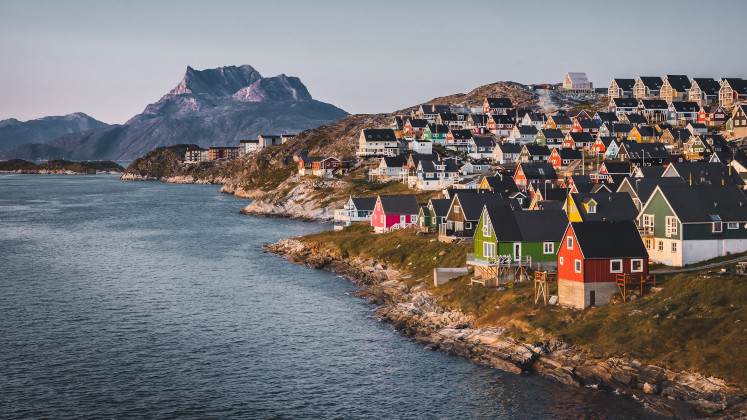
Why does President Trump want Greenland? Klaus Dodds writes that while Trump has emphasised US national security, his ambitions are for nothing short of western hemispheric dominance.
In January 2025, Donald Trump in the first month of taking presidential office again reiterated an earlier interest in acquiring Greenland. Publicly rebuffed in 2019, during his first administration, the President has returned to the topic with gusto. The last 12 months have been breath-taking in terms of how the territorial integrity of Denmark, a NATO ally, has been called into question.
When Trump volunteered an interest in acquiring the world’s largest island, academic commentary was punctuated by a contextual discussion which noted previous presidential interest. In 1946, President Truman offered to purchase Greenland from Denmark and when that was declined politely, it led to the 1951 Defence Agreement between Washington and Copenhagen.
Denmark, Greenland and the United States
Up until 2019, the US had been a dominant security partner acknowledging over time that the status of Greenland within the Kingdom of Denmark has changed. In the 1960s, the US stationed nuclear-carrying bombers at their Thule military base and did not inform the Danish government.
A notorious accident in 1968 called the Thule disaster involving an American B-52 carrying nuclear weapons revealed the scale of the deceit. Greenland was still a colony of Denmark and it experienced a nuclear accident of some significance.
By the time Trump made that first offer, well-developed indigenous autonomy in Nuuk complemented the formal responsibilities of Copenhagen for foreign and security policy. Two referendums in 1979 and 2008 revealed clearly the preferred direction of travel. Greenlandic people can imagine the island being independent but recognise for now that Denmark’s block grant worth some 500 million euros every year is integral to societal well-being.
When the then Prime Minister of Denmark withdrew the offer of a state visit to President Trump in 2019, it was done with the full engagement and support of the Government of Greenland. There may have been a temptation to think that after Trump lost the 2020 presidential election, American interest would terminate. During the Biden administration the Thule base was renamed the Pituffik Space Base in 2023, and has responsibility for missile warning, hemispheric missile defence and space surveillance missions.
Hemispheric dominance
That assumption, if made at the time, proved to be erroneous. Even as President-elect, Trump was posting on Truth Social that the United States needed in one form or another Canada, Greenland and the Panama Canal to be within its bailiwick. By the time Trump delivered the state of the union address in January 2025, there was further evidence of an outline of ambition.
What linked the three together was a sense in which US national security going forward depends on western hemispheric dominance, informed by a reading of both Canada and Greenland as vast, thinly populated and resource-rich northerly spaces.
The Panama Canal was linked to the more northerly territories by a shared conviction that China has been plotting and planning ambitious investment programmes in the canal zone alongside mining and infrastructure sectors in Canada and Greenland.
For a president who is not known for taking a great deal of interest in climate change, the posts suggested an appreciation that the Arctic was opening to increased shipping activity and that the Panama Canal was prone to drought-based water shortages.
Blunt force geopolitics in action
When President Trump rekindled this interest in acquiring Greenland in 2025, the tone and context was quite different to 2019. The State of the Union address itself was not an exercise of subtlety. The President declared that the United States would “get” Greenland. At the same time, an Executive Order declared that henceforth the Gulf of Mexico would be renamed the “Gulf of America” and that there would be a return to “Mount McKinley” in Alaska.
Notably, the Order was titled “Restoring names that honour American greatness”. In February 2025, the US Board on Geographic Names (BGN) updated the official place names database, and 9 February was declared to be the inaugural “Gulf of America” Day. Place naming not only signifies ownership of a territory or place but also symbolically marks the political and cultural dominance of one group, and one geopolitical relationship, over others. This is blunt force geopolitics in action.
Another crucial shift from 2019 to 2025/6 was Ukraine. Nearly four years after the full-scale invasion of Ukraine by the Russian Federation, the quest for Greenland must be understood within a wider turn towards land grabbing. And not just in Ukraine itself.
Regional powers such as Israel and Türkiye have used crises in Gaza and Syria to grab land and secure further strategic advantage. China is tightening its grip around Taiwan and the South China Sea and stands accused of stealing land in the high-altitude borderlands with India.
Demands for enhanced food and water security will place ever greater pressures on common spaces such as oceans and seas. In 2024, it was reported that 60% of the global land area was affected by drought at some point in the year. And with recent events in Venezuela, the US launched an operation to remove a widely despised regime in an intervention widely assumed to be based in part on the South American country’s vast proven oil reserves.
Why does Trump want Greenland?
If we had to answer the question, why does Trump want Greenland, the answer would not be a singular response. He has been clear that the US needs the island for “national security”. This is echoed in the 2025 National Security Strategy, which is clear that Washington will prioritise the Indo-Pacific region and western hemispheric defence.
Owning Greenland could be understood as simply a staging ground for high-latitude missile and space defence as well as providing opportunities to develop land and port-based facilities designed to secure domain dominance. Despite recent Danish pledges to increase their defence commitments in Greenland, there is no question that Trump thinks the Danes have been delinquent. Denmark cannot be trusted with the defence of the island ergo the United States must step in now.
Second, there is no question that the mineral resource potential of Greenland looms large including rare earths. While the Greenlandic mining sector is a work in progress, there is little doubt that a resource calculation in Washington DC has been done.
Chinese companies have attempted to invest in Canadian and Greenlandic mining projects as well as Greenlandic airport and port facilities. Greenland and Canada are both seen as resource frontiers for a future US, in a large country that will have its own challenges to confront including extreme heat, fire and flooding alongside water shortages. Land, water and resources are driving some of this.
Trump will not tolerate a Chinese foothold in Greenland, and the Danish government has blocked some of these overtures. Some estimates have put the rare earth potential of Greenland on par with the United States. What has stopped investment in the recent past has simply been the high operating costs of developing critical mineral supply chains, noting a shortage of infrastructure and skilled labour.
Finally, this in the end might be about ego-politics. President Trump likes maps. He understands the lure of real estate deals. He wishes to be the president that made America great again.
Over 40% of the territorial expansion of the United States came through land purchasing and the “Trump purchase” would add further land and resources as well as contribute to his determination to establish hemispheric domination. The next step is likely to be a lucrative offer to the Greenlandic people to join in a free association with the United States. If that is rejected then all bets are off.
What is adding further zest to all of this is whether the United States and Russia end up doing a series of deals which facilitates Russia’s acquisition of eastern Ukraine and occupation of Svalbard, a Norwegian territory long coveted by Moscow.
All of which would strengthen further Russia’s northern bastion, where the nuclear deterrent is in Northwest Russia. Russian nationalists have been calling for Svalbard to be renamed the Pomor Islands as part of the Russification of the archipelago.
Both Putin and Trump have a keen sense of wishing to make their respective countries great again and are completely indifferent to the territorial integrity and formal sovereignty of near neighbours.
President Trump clearly wants to be a hemispheric president and finish what James Monroe started some 200 years ago.
Note: This article gives the views of the author, not the position of LSE European Politics or the London School of Economics.
Image credit: Mathias Berlin provided by Shutterstock.






Discussion about this post