




















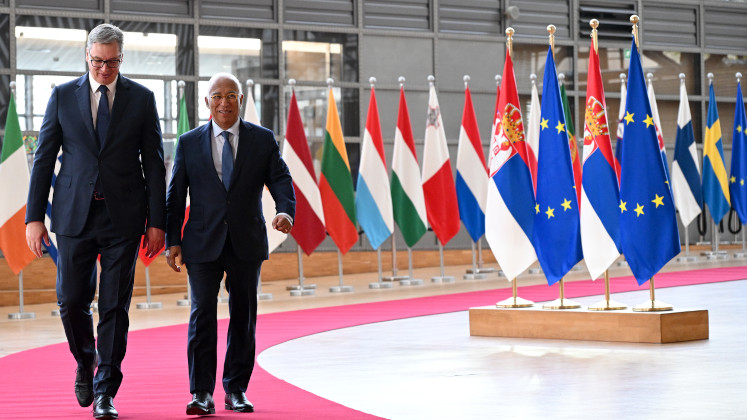
What makes a country European? Drawing on new research, Sandra Obradović shows that when states are recognised as being European, their citizens are more likely to support European cooperation.
What does it mean to be European, and who gets to decide? At a time when Europe faces mounting challenges, from Russian aggression in Ukraine to economic instability and the climate crisis, solidarity and cooperation are essential.
Yet many countries find themselves in an uncomfortable liminal space: geographically in Europe but perpetually questioned about whether they’re “European enough” and criticised by EU institutions for their failures to meet certain standards. But does this have any real implications for geopolitical cooperation?
In recent research, I (alongside my co-authors) have examined this question by looking at how people in Romania, Serbia and Türkiye – three countries often positioned as “in-between” East and West – understand Europeanness and where they see themselves represented in this supranational identity. Our findings speak to the political consequences of psychological group boundaries, even for a group as abstract as “Europe”.
Mapping the mental geography of Europe
We began this project by asking people which countries they saw as most and least European and why. Across all three samples, Germany emerged as the clear prototype of Europe (the ideal-type member) with over 75% of people in each country including it in their top five most European nations.
When explaining their choices, participants emphasised strong economies, advanced education systems, democratic governance and being “developed in all respects”. In contrast, countries seen as least European were described as economically weak, politically corrupt, lacking in civil rights and as not yet having achieved that level of development.
Being “European” was to these participants not just about geographic location but about economic, social and political development. This language of development and trajectory is important for understanding how people perceive Europe. It is not just a continent but a kind of development endpoint – something that nations can “become”.
Internalised hierarchies
In a second study, we wanted to examine how people compare themselves to the prototype. We asked participants to describe characteristics of their own national group compared to Germans and vice versa. Germans were described as disciplined, punctual, organised and hard-working, while participants’ own national group was characterised as hospitable, friendly and warm, but also lazy, unorganised and corrupt.
Across all three countries, we found a pattern consistent with the Stereotype Content Model, which suggests that lower-status groups often engage in “outgroup favouritism”, attributing more positive characteristics to higher-status others. This complementary stereotyping shows acceptance of one’s lower position within European symbolic hierarchies, coupled with compensatory emphasis on interpersonal warmth that higher-status groups supposedly lack.
Does recognition matter? An experimental test
While the prototype of Europe might be more western-centric, an important question is whether this has any tangible consequences for the geopolitics of non-western countries. In a final experiment we therefore wanted to examine what happens when more “prototypical” Europeans explicitly recognise – or deny – a country’s Europeanness?
Participants read a vignette claiming that Germans either viewed their country as “very European” or “not very European”. We then measured their attitudes toward membership in the EU (in the case of Romania remaining a member), NATO and Schengen, as well as support for European cooperation on transnational issues such as a refugee crisis.
For Romanians and Serbians, positive recognition mattered. Romanian participants who read that Germans saw Romania as very European showed significantly stronger support for EU membership, NATO membership, joining Schengen and European cooperation.
Serbian participants showed similar patterns for EU and Schengen support as well as cooperation, with negative recognition decreasing their support. Recognition didn’t affect Serbian attitudes toward NATO, which makes sense given Serbia’s history with the 1999 NATO bombing.
However, recognition from Germans had virtually no effect on Turkish participants’ attitudes. This suggests that when a country reorients away from Europe, as Türkiye has been doing in recent years, recognition within European frameworks loses its psychological power. You can’t affect attitudes through recognition when people no longer care about the category you’re recognising them within.
The dialogical nature of European identity
These findings challenge traditional psychological approaches to group identification, which emphasise self-categorisation – how individuals claim membership in groups. Our research demonstrates that identification, particularly with hierarchical superordinate categories like “Europe”, is fundamentally “dialogical”. It emerges from the interplay between claims to membership and the recognition of those claims by others, especially others positioned as more prototypical or powerful.
Crucially, this dialogicality isn’t simply social-psychological, it’s deeply embedded in geopolitical realities. Formal membership in institutions like the EU or NATO provides objective recognition that can buffer against symbolic denial. Romania’s EU membership may explain why negative recognition from Germans had less impact there than in Serbia, which remains a candidate state navigating between competing geopolitical forces.
Implications for European cooperation
These dynamics have practical implications for European policymaking. If we want countries on Europe’s periphery to support European institutions and cooperation, we need to pay attention to symbolic recognition and who gets to define what Europeanness means.
Positive recognition can increase support for European cooperation, but sustained non-recognition can lead to disengagement and alternative identity projects. Once that happens, as we’re seeing with Türkiye, recognition may come too late to matter.
At a time when Europe needs solidarity to face shared challenges, we cannot afford symbolic boundaries that make some countries feel perpetually marginal. This doesn’t mean abandoning standards, but it does mean being conscious of how Western European experiences have come to define the prototype of Europeanness.
Recognition has tangible effects on political attitudes toward cooperation. If we want a Europe that works together effectively, we need to think carefully about who belongs, who decides and how the boundaries of Europeanness are drawn and maintained.
For more information, see the author’s recent studies in the Journal of Social Issues (co-authored with Reşit Kışlıoğlu, Nihan Albayrak, Mihaela Boza, Amena Amer and Murray Kennedy) and Political Psychology (co-authored with Nihan Albayrak-Aydemir, Amena Amer, Mihaela Boza and Reşit Kışlıoğlu).
Note: This article gives the views of the author, not the position of LSE European Politics or the London School of Economics.
Image credit: European Union.




Discussion about this post