



















As part of peace negotiations between Armenia and Azerbaijan, the United States has proposed a “Trump Route for International Peace and Prosperity” (TRIPP) that would connect Azerbaijan with the exclave of Nakhchivan. Pınar Sayan writes that while the plan offers a pragmatic approach to conflict resolution, long-term stability will require a more inclusive peace process than what we have seen so far.
The Second Nagorno-Karabakh War ended with a Russian-brokered ceasefire on 9 November 2020. This was followed by Azerbaijan’s assertion of full control over Nagorno-Karabakh and surrounding regions in September 2023.
Since then, Armenia and Azerbaijan have engaged in intermittent peace negotiations, with Russia, the European Union and the United States acting as mediators. In March 2025, the parties agreed on the basic framework of a peace agreement.
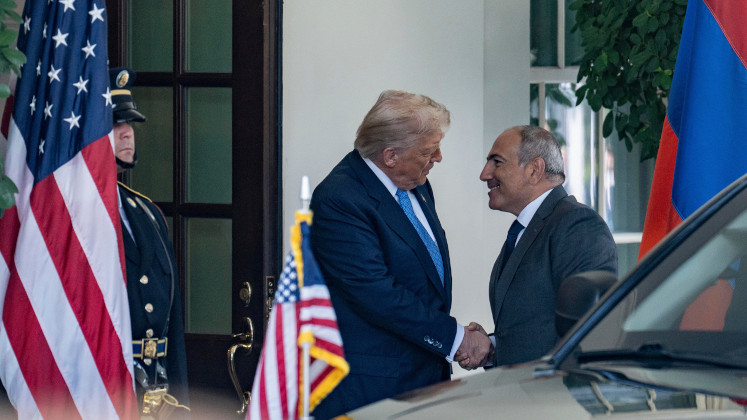
On 8 August 2025, US President Donald Trump hosted Armenian Prime Minister Nikol Pashinyan and Azerbaijani President Ilham Aliyev at the White House. The summit concluded with the signing of a Joint Declaration (the Washington Declaration) and accompanying memoranda of understanding envisaging cooperation in several sectors including energy security, border security and infrastructure modernisation.
The most critical element, however, was the announcement of the Trump Route for International Peace and Prosperity (TRIPP), a connectivity initiative. As a result, the Washington Declaration positioned the US as the primary, albeit informal, guarantor of the agreement.
President Trump framed this summit as a personal diplomatic triumph, adding it to the list of eight conflicts he claims to have ended. Trump’s personal involvement nonetheless elevated international attention to the region, particularly in Europe, where policymakers have been largely sidelined in the mediation efforts since 2023. This renewed focus has prompted pressing questions about the peace agreement.
What the peace agreement includes – and what it doesn’t
Under the agreement, the parties reaffirm mutual sovereignty and territorial integrity, commit to establishing diplomatic relations and pledge they will work toward a peaceful resolution of disputes.
On border delimitation and demarcation, respective border commissions have been working on the issue since their establishment in 2022 and recently concluded their 12th meeting. While specific timelines and enforcement mechanisms remain unclear, the agreement underscores this commitment.
Regarding mutual allegations of war crimes, the agreement envisages information exchange, cooperation and investigations concerning missing persons and enforced disappearances as a reconciliation mechanism. In addition, lawsuits filed to the international judicial bodies including the International Court of Justice, the International Criminal Court and the European Court of Human Rights are to be mutually withdrawn or settled.
The agreement also restricts the deployment of third parties at the mutual border, a provision that might limit Russia’s involvement as well as that of the EU. The EU currently maintains a border monitoring mission.
Although not mentioned directly in the agreement, Armenia’s constitution remains a sensitive issue. Azerbaijan has repeatedly argued that Armenia’s 1995 constitution – by referencing the 1990 Declaration of Independence, which in turn cites a 1989 resolution on the “reunification” of Armenia and Nagorno-Karabakh – constitutes an implicit territorial claim.
Constitutional amendments in Armenia require a referendum, and Prime Minister Pashinyan announced that a referendum on a new constitution will be held after the parliamentary elections scheduled for June 2026.
In addition to the constitutional sensitivities, the peace agreement does not make any reference to the rights of displaced Karabakh Armenians or the status of Armenian prisoners while recognising Azerbaijani sovereignty over Karabakh and abandoning international legal claims. Hence, election results and constitutional amendments in Armenia will be detrimental to the ratification of the agreement.
TRIPP and the politics of connectivity
A key focus at present is Nakhchivan, the landlocked exclave of Azerbaijan that is separated from the rest of the country by Armenian territory. The November 2020 ceasefire included a provision for reopening communications between Azerbaijan and Nakhchivan through Armenia’s southern Syunik region.
However, the parties failed to agree on the legal regime governing this route. Azerbaijan and Türkiye refer to the project as the “Zangezur Corridor”, a term Armenia rejects as a challenge to its sovereignty. Yerevan instead proposed the “Crossroads of Peace” initiative, emphasising Armenian jurisdiction over all transport routes, which is rejected by Baku.
TRIPP appears to offer an unexpected compromise to overcome the deadlock by internationalising the corridor. On 13 January 2026, the US Secretary of State Marco Rubio and Armenian Foreign Minister Ararat Mirzoyan further announced a TRIPP Implementation Framework (TIF) following their meeting in Washington.
The TIF envisions the establishment of a “TRIPP Development Company”. For the initial 49-year term, the US will hold 74% of the shares in this company, while Armenia will hold 26%. If extended for an additional 50 years, Armenia’s share will increase to 49%. The company will be responsible for developing and operating rail, road, energy and digital infrastructure.
The TIF addresses the central political sensitivity of Armenia by explicitly stating that Armenia has full sovereignty over all TRIPP areas, including legislative, regulatory and judicial authority. To facilitate operations, a “front office-back office” model will be employed: third party operators will manage customer-facing services in the front office, while Armenian state authorities will exercise all sovereign authority in the back office.
Geopolitical Implications
While the US seeks to expand its influence in the region through TRIPP, the TIF underlines that progress depends on parallel peace processes between Armenia and Azerbaijan, as well as between Armenia and Türkiye. Increased US involvement in the South Caucasus inevitably raises questions of Russia and Iran.
Having seen its influence wane since 2022, Russia so far has reacted cautiously but without overt opposition. Iran, by contrast, may face strategic losses as routes bypassing Iranian territory weaken Tehran’s role in regional transit and deepen its isolation. Russia and Iran’s reactions to TRIPP and US involvement may also complicate the ratification process.
Türkiye has long sought direct connectivity between Azerbaijan and Nakhchivan, aligning Ankara’s vision of a continuous corridor extending into Central Asia to reduce transportation costs. Moreover, progress in peace negotiations between Armenia and Azerbaijan also contributes to the normalisation process between Armenia and Türkiye, which may in turn lead to the opening of borders between them.
In addition to the earlier normalisation steps, Turkish Airlines has recently launched new routes to Yerevan, and the two countries have agreed on mutual visa facilitation. Although the EU seems to be sidelined, it may still play an important role in technical assistance and infrastructure investment for both processes.
The need for a more inclusive process
TRIPP represents a pragmatic, connectivity-driven, top-down approach to conflict resolution that prioritises interdependency and economic integration. Recent developments, such as reciprocal visits, Azerbaijan supplying oil to Armenia and the release of prisoners can be considered as confidence-building measures.
A key test will be the European Political Community Summit scheduled to be held in Yerevan on 4 May 2026. The participation of Azerbaijani and Turkish political leaders at this summit would constitute a powerful symbolic signal.
Finally, ensuring long-term stability will require a more inclusive peace process than what we have seen so far. It is therefore vital that if the agreement is ratified, the official steps taken at the political level are complemented with civic initiatives.
Note: This article gives the views of the author, not the position of LSE European Politics or the London School of Economics.
Image credit: DT phots1 provided by Shutterstock.




Discussion about this post