






















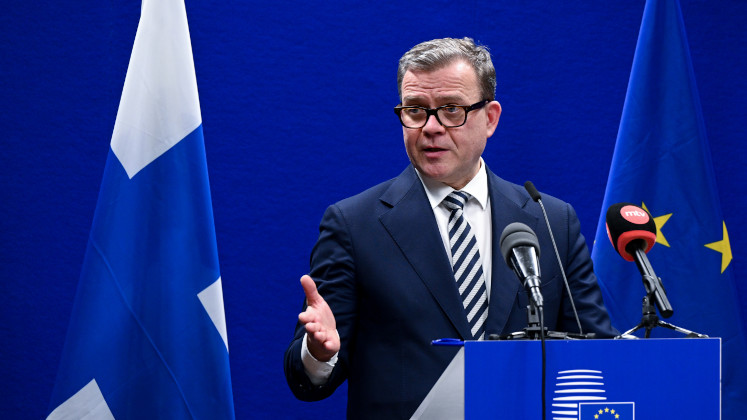
After winning power in 2023, Finnish Prime Minister Petteri Orpo oversaw sweeping labour market and social security reforms. Markku Sippola argues the reforms have not only failed to create economic benefits but have profoundly damaged Finland’s industrial relations model.
In 2024, I anticipated that sweeping labour market and social security reforms implemented by the newly appointed Finnish government, led by Petteri Orpo, would “risk doing more harm than good”. This risk is now being realised.
The changes included making it easier to dismiss employees, relaxing regulations on fixed-term contracts and reducing unemployment benefits, while also making access to social assistance more difficult and lowering the level of compensation. A stated goal was to increase incentives for unemployed people to find work. The Prime Minister’s party promised to create 100,000 jobs.
Simultaneously, the government aimed to dismantle decades-old industrial relations structures. Reforms included abolishing the tax exemption for trade union membership fees, allowing non-union representatives in local bargaining, limiting political strikes, increasing penalties for participation in “illegal” strikes and reducing the national conciliator’s power to propose sector-level wage increases.
Most of these changes were implemented rapidly after the government took power. Unsurprisingly, the reforms sparked massive strikes by Finnish trade unions, which viewed them as a deliberate attempt to weaken their influence. However, the government remained steadfast.
It argued that existing labour market structures had led to poor employment outcomes, citing Finland’s high unionisation rates and strong collective agreements. Employer associations viewed the centralised wage-setting system as a source of market rigidity, although it had also provided a mechanism through which Finland maintained one of Europe’s lowest in-work poverty rates.
False alarms
The government also sought to reduce public debt through austerity policies, cutting subsidies to NGOs and other areas of public spending (though not the defence budget). In 2023, the Orpo government framed Finland’s situation as a major “debt crisis”, using this narrative to legitimise its labour market reforms and austerity policies.
The Orpo government proceeded with its reforms unilaterally, without involving labour market actors, including employers’ organisations and trade union confederations. This differed from the COVID-19 crisis – which was a genuine crisis – when the previous, pro-labour Marin government made a tripartite effort to help mitigate economic distress. Marin’s cabinet involved the labour market parties in this process.
At the outset of the Orpo reforms, Finland’s economic situation was by no means catastrophic. Employment was growing until 2023, the year the Orpo government took office. Government debt, while increasing, was not yet alarming.
The government sought to reduce the budget deficit by cutting social security and public spending. Simultaneously, it reduced taxes, thereby eroding the tax base. This wave of austerity sent a clear signal throughout the economy: save if you can. As a result, households and businesses contracted their economic activity.
Stalled employment development
Finnish GDP grew moderately from 2022 to 2024, although growth was not rapid when compared to peer countries like Denmark, Germany, Japan, Sweden, the UK and the United States. Productivity, measured as GDP per hour worked, increased quite remarkably in Finland – this is the positive development.
On the other hand, employment stagnated and has remained the lowest among the peer countries mentioned, while Finland is the only country in this comparison where government debt has grown significantly during this period. Even Japan, with a more adverse demographic profile than Finland’s, has succeeded in reducing its debt.
The outcome of the Orpo government’s austerity policies, combined with labour market reforms, has been almost the opposite of what was intended: government debt has surged, and the most urgent reforms aimed at altering labour conditions have had no observable effect on labour market dynamism.
The Orpo government has also tightened migration legislation (e.g. shortening the right to remain in the country in cases of unemployment, raising minimum income thresholds and cutting integration services), partly due to the inclusion of the migration-sceptic Finns Party in the governing coalition.
This may be seen as constraining Finland’s economic growth in the context of an ageing population. However, the share of the foreign-born population actually increased in Finland by a few percentage points between 2020 and 2024, although the figure still remains below that of countries like Denmark, Germany, Sweden, the UK and the United States.
Impact on industrial relations
The moves by the Finnish government signify a break with a decades-long tradition of tripartite consultation and negotiation. The current government has justified this shift by invoking its mandate to govern in matters of labour and social legislation, grounded in the principles of parliamentary democracy.
Government and business actors in Finland have framed the unilateral labour reform proposals as a defence of democracy, while trade unions’ subsequent opposition has been portrayed as undemocratic.
While it is true that one pillar of the Finnish industrial relations model has been strong government involvement in wage formation and policymaking, this has long been accompanied by a second pillar: the significant influence of social partners in shaping the social security system.
Although Finland’s gross domestic product and productivity have improved – which is also true of other countries – employment rates have stagnated and government debt has increased, thereby undermining the original objectives of the reforms. The promising growth of employment in the beginning of the 2020s has stalled and the growth of state debt has become alarming.
The government’s unilateral “shock therapy” approach appears aimed at weakening trade unions and strengthening employers’ managerial prerogatives. Employer authority was already stronger in Finland than in Denmark and Sweden prior to the Orpo reforms.
Moreover, the manner in which the reforms were implemented departs from the tradition of social dialogue that is characteristic of neighbouring Nordic countries, where labour market stakeholders are typically involved in reform processes. In the course of these reforms, it seems to have been overlooked that a well-functioning industrial relations system is complementary to a dynamic labour market in the Nordic context.
Note: This article gives the views of the author, not the position of LSE European Politics or the London School of Economics.
Image credit: European Union.






Discussion about this post