






















Latin America’s international relations are often viewed through the lens of US hegemony. Yet as Charlotte Eaton explains, this risks obscuring the important historical connections between Latin America and Europe.
It is common, in both popular and historical narratives, to view Latin America’s twentieth-century international relations primarily through the lens of its tempestuous relationship with its northern neighbour.
This narrative has been promoted both within the United States – which, since the mid-19th century, has sought to define the region as its own “backyard” – and across Latin America, where various groups have pointed to US imperialism to further their own political, social and cultural agendas.
Given the current state of international affairs, it is worth revisiting this assumption. The adversarial foreign policy of Donald Trump has catalysed moves across the world to seek or strengthen alliances elsewhere. This is particularly true in Latin America and Europe, both heavily impacted by the US president’s tariff war.
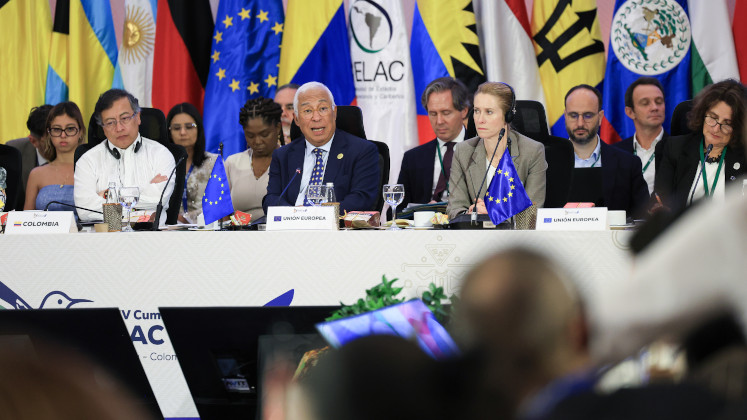
On 9 November 2025, delegates from the two regions met in Colombia for the fourth summit of the European Union and Community of Latin American and Caribbean States. At the summit, leaders and representatives from both sides of the Atlantic agreed to strengthen their bi-regional relationship based on “shared values and interests”. A joint statement from both bodies declared that this decision was “driven by the will to deepen the historical ties that unite us”.
Europe and Latin America in the 20th century
What then, are these historical ties? One could look to the colonial period, when the Portuguese, Spanish, French, British and Dutch sought colonies abroad that could fuel their domestic economies. Or to the post-independence period when many of these same countries sought to finance state-building projects or establish their control over local industries.
Yet it seems unlikely that these eras offer examples of the shared interests and values that the statement refers to. Instead, we need to look to the 20th century when, building on the various networks established during the earlier periods of formal and informal empire, Latin Americans and Europeans forged a variety of new connections which remade the previous hierarchical relationship. The results of this process shaped developments on both sides of the Atlantic, and sometimes even in the wider world.
Sometimes, Latin American and European officials sought ties as a direct counterweight to US influence during a crucial moment for the Monroe Doctrine. Take Mexico and Germany during the early twentieth century. In 1915, amidst the ongoing Mexican Revolution and First World War, Mexican exiles in the United States appealed to the German imperial government for financial support of their campaign to launch a rebellion against the new US-backed revolutionary leader Venustiano Carranza.
This paved the way for the infamous Zimmerman telegram of 1917, as the exiles also wanted to recover territory lost during the Mexican-American War. Rather than view Latin America as a mere arena for “Great Power” machinations, then, we can see how groups in both that region and Europe attempted to leverage international and national power struggles for their own benefit.
Transatlantic flows
Mostly, however, Latin American-European relations in the 20th century had very little to do with the United States. Instead, they were shaped by the transatlantic flow of people and ideas that had been ongoing for centuries but were dramatically altered by new regional and global developments.
In the early 1800s, as South American independence leaders sought to create sovereign nations out of vast territories and diverse populations, they sought inspiration from the French Revolution and enlightenment authors. When large swathes of migrants arrived in Latin America from Europe during the late 19th and early 20th centuries, they brought with them socialist and anarchist ideas and forms of labour organisation.
However, this was not a case of simple transplantation. Debated in new environments, these philosophies were transformed and, in some instances, sent back out to the rest of the world. In one notable example from the 1920s, the Peruvian José Carlos Mariátegui criticised the Eurocentricity of traditional Marxist theory and developed his own Latin American Marxism. His adaptation of communist ideology had enough of an international impact that the Comintern denounced him as a populist.
A more egalitarian relationship
In these examples, and more, a sense of common beliefs and goals emerged for various Latin Americans and Europeans. In turn, this shaped a new era in the two regions’ international relations which began in the late 20th century.
During the period of dictatorships in the Southern Cone and conflicts in Central America, both state and non-state groups sought to establish new diplomatic and transnational links to Europe. Argentinian, Chilean and Paraguayan exiles, for instance, established solidarity networks across the continent that were vital in highlighting the human rights abuses being committed in their home countries.
Following the Nicaraguan Revolution, the Sandinista National Liberation Front pursued alliances with Western European governments as a means to seek a “third way” during the ongoing Cold War. Although these initiatives met with varying success – Chilean exiles’ resistance contributed greatly to Pinochet’s arrest in 1998 while the Sandinistas’ relationship with Europe ultimately undermined their revolution – they do point to the development of a more egalitarian relationship between the two regions. It is this reimagined relationship that allows present-day leaders in Latin America and Europe to speak of shared interests and values.
For more information, see the author’s accompanying paper in The Americas.
Note: This article gives the views of the author, not the position of LSE European Politics or the London School of Economics.
Image credit: European Union.






Discussion about this post