




















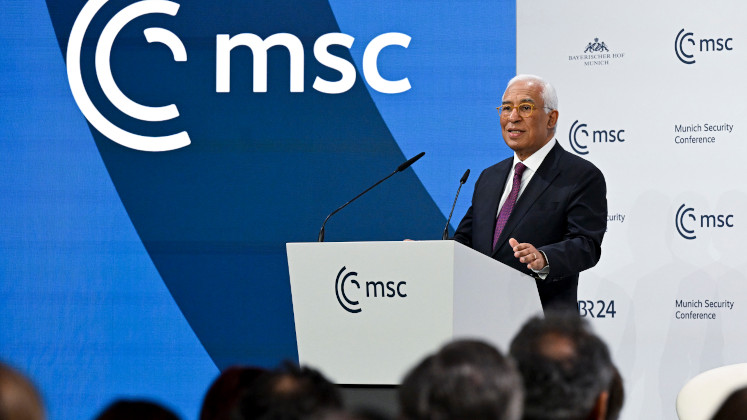
This week’s Munich Security Conference will once again put the transatlantic relationship under the spotlight. Teona Giuashvili argues that as the US grows increasingly unreliable, European leaders must now lay the foundations for an independent Europe.
President Trump’s unprecedented threat to seize Greenland carried both historical echoes and a sense of looming uncertainty, signalling a rupture in the post‑1945 liberal order. His subsequent climbdown – while refusing to renounce the underlying ambition – brought European leaders a measure of relief.
Although the immediate anxiety has subsided, the collateral damage is substantial. Eight decades of partnership have been severely strained, and trust among allies has eroded, leaving the US with a markedly diminished image and reputation. Public opinion across Europe has grown increasingly unfavourable, with only a small minority still viewing the US as a dependable ally – even in traditionally Atlanticist countries such as Poland and Estonia.
The situation has become so acute that political rivals who rarely align – Emmanuel Macron and Jordan Bardella in France, as well as Keir Starmer and Nigel Farage in the United Kingdom – have found themselves voicing similar concerns about President Trump’s disparaging of European allies.
If further evidence were required, the crisis over Greenland underscored that the US can no longer be regarded as a reliable partner, led by a president whose strategic unpredictability represents the only factor of continuity in the current administration’s foreign policy and who has elevated disregard for traditional partners into a defining feature of his leadership.
A problem of Europe’s own making
Many of the challenges that Europe faces today are self‑inflicted. For decades, European capitals underestimated the scale of the threat posed by Russia while simultaneously discounting repeated warnings from the US that Europe needed to assume greater responsibility for its own security.
Since at least 2008, the EU overlooked clear signals of Moscow’s revisionist ambitions. A blend of economic self‑interest, political complacency and the belief that interdependence would restrain Russian behaviour produced a dangerous misreading of the threat.
Even after the annexation of Crimea in 2014, many European governments – France, Germany and Italy among them – continued to treat Russia as a difficult partner rather than a strategic adversary, allowing energy dependence and diplomatic wishful thinking to shape policy.
First, they misjudged the scope of Russia’s neo-imperial project, consistently overlooking Moscow’s long‑term strategic ambitions and its determination to reshape the European security order. Second, by deepening their energy dependence on Russia, they effectively helped finance the war against Ukraine – and, indirectly, undermined their own security. This dependence constrained Europe’s strategic autonomy while providing Russia with the resources and leverage it later deployed in its military campaigns.
Finally, Europe’s weak political responses to earlier acts of aggression – against Georgia in 2008 and Ukraine in 2014 – emboldened Moscow. The absence of robust deterrence signalled to Russia that the costs of further escalation would be limited, reinforcing the Kremlin’s belief that it could act with impunity.
Over the same period, Washington repeatedly signalled that the US was not prepared to underwrite Europe’s security indefinitely. Successive US administrations pressed European governments to increase defence spending and take on more responsibility for their own neighbourhood.
Yet many European states continued to rely heavily on American protection, even after Russia’s full‑scale invasion of Ukraine exposed the extent of this dependence. It ultimately took the shock of President Trump’s belittling of NATO and of US allies to prompt European leaders to change gear and commit to strengthening their own security.
While NATO allies – Spain excepted – have pledged to raise defence spending to 5 percent of GDP by 2035, 23 of the Alliance’s 32 members now meet the 2 percent benchmark, the highest number in NATO’s history. If President Trump’s threat to disengage from NATO unless European allies increase their defence spending helped drive this shift, it is equally the case that his explicit contempt for NATO allies places the Alliance’s cohesion at significant risk.
Haunting reliance on the US
Since Donald Trump returned to the presidency, Europeans have taken on the lion’s share of support for Ukraine. Over the first three and a half years of the war (up to November 2025), the EU and its member states contributed €177.5 billion to Ukraine, far surpassing the US when financial and military assistance are combined. Since spring 2025, US financial support has effectively run dry.
As Emmanuel Macron has noted, France alone now provides approximatively two‑thirds of Europe’s military intelligence. Germany’s largest defence manufacturer, Rheinmetall, is on track to produce 1.5 million 155mm artillery shells annually by 2027 – eclipsing the combined output of the US defence industry.
These are steps in the right direction, but they are belated. These advances do not alter the underlying reality that Washington’s logistical backbone, intelligence capabilities and industrial scale remain essential for the defence of Ukraine and Europe, at least in the short to medium-term.
Since Russia’s full-scale invasion of Ukraine, European NATO members have, if anything, become more dependent on US weapons supplies. According to a report by the Stockholm International Peace Research Institute (SIPRI), between 2020 and 2024 European arms imports increased by 155 percent compared with 2015-2019, and the US share of these imports rose from 52 percent to 64 percent.
Under NATO’s Prioritised Ukraine Requirements List (PURL) initiative, European governments, together with other NATO allies and partners, have already pledged more than 4 billion dollars for the purchase of American weapons for Ukraine and committed to spending 1 billion dollars every month. Furthermore, as part of the Brussels-Washington tariffs trade deal, the EU pledged to increase defence procurement from the US to strengthen NATO interoperability.
Europe’s military reliance on the US has moved in parallel with its energy dependence. As Europe unwinds its dependence on Russian energy, it is becoming increasingly reliant on the US – currently the source of 60 percent of its LNG imports and 14.5 percent of its oil.
Washington’s role as Europe’s ultimate security guarantor has given the US disproportionate influence over strategic decisions far beyond defence. From technology regulation to China policy, the US has repeatedly leveraged Europe’s strategic vulnerability to shape outcomes on its own terms. President Trump’s willingness to weaponise this dependency illustrates the extent of this imbalance.
The idea of “Europe’s weakness” has become a convenient rhetorical device for Donald Trump and other US officials, who have invoked it to diminish European partners, cast doubt on the value of transatlantic cooperation and justify their ambitions regarding Greenland. Even if European leaders succeed in keeping the US engaged in Europe’s security – albeit at considerable political and economic cost – one must ask what value that engagement still holds when the foundation of trust has largely eroded.
Between a rock and a hard place
Although European capitals displayed a degree of cohesion in responding to the US during the Greenland crisis, their convergence on shared priorities cannot be taken for granted. Threat perceptions and the ranking of strategic priorities continue to differ across Europe. At the same time, governments face growing domestic political polarisation, which limits their capacity to sustain a coherent strategic approach and to invest meaningfully in European sovereignty.
Europeans have closed ranks and mobilised considerable resources to back Ukraine and contain Russia. While the recognition of the Russian threat is no longer limited to Eastern and Northern Europe, the sense of urgency still varies across the continent.
The mood in European capitals oscillates between preparing for a Russian attack, which numerous intelligence reports consider possible within a handful of years, and complacency about the seriousness of the threat. Between these two poles lies an insidious reality: since invading Ukraine, Russia has expanded hybrid warfare across the entire continent, targeting Europe’s institutional integrity and societal cohesion. As the head of British intelligence recently warned, Russia is testing Europe’s resilience below the threshold of war.
Nothing captures Europe’s uneven mobilisation to counter Russian aggression more clearly than defence spending. Despite an overall rise in EU military expenditure, only Poland and the three Baltic states allocate more than 3 percent of their GDP to defence. While Germany’s Zeitenwende has generated record investment in military modernisation, other countries – such as France, Italy, Spain and Belgium – remain constrained by tighter fiscal conditions.
Balancing security imperatives with welfare expectations has become one of the EU’s most politically sensitive challenges. And although Europeans broadly acknowledge defence and security as strategic priorities, the latest Eurobarometer shows that inflation, rising prices and the cost of living continue to dominate public concerns.
Europe’s ability to deter Russia while reducing its dependence on the US hinges not only on resources but on political will – the broader mental shift required to recognise the structural changes reshaping the transatlantic relationship and to embrace a more autonomous strategic mindset. The continent has the economic weight to secure itself and sustain Ukraine, yet it still struggles to internalise the lesson that its security cannot rest on the temperament of a US president.
There is no structural reason why a union of 450 million people with an €18‑trillion economy cannot defend Ukraine and guarantee its own security, even amid economic pressures and welfare constraints. Europe’s challenge is partly one of material capabilities, but even more fundamentally one of mindset, self‑confidence and unity.
In this respect, the erratic approach of the Trump administration to the war in Ukraine, while seeking to partner with Russia, has produced a significant shift in Eastern and Northern Europe.
The countries historically most exposed to Russian aggression have long been the most fervent supporters of NATO and broader transatlantic alignment. Today, they remain staunchly committed to the Atlantic Alliance but increasingly recognise that Europe must reduce its dependence on a less reliable America and assume far greater responsibility for its defence.
Rebuilding an independent Europe
Recent experience shows that efforts to curry favour with the current US administration do not yield meaningful influence. Europe therefore needs a strategy that moves beyond mere damage control. What is required is the hard, sustained work of turning political commitments into credible capabilities and concrete action, laying the foundations for a more “independent Europe”.
The foreign policy of a more confident and autonomous Europe should rest on four priorities to stabilise the continental security order and strengthen cooperation with likeminded powers worldwide.
First, integrating Ukraine within the EU and providing credible security guarantees to Kyiv will be the litmus test of Europe’s strategic maturity. This is not only a political imperative for a country that has paid an extraordinary price to defend the very principles that the EU and NATO claim to uphold. Strategically, incorporating Ukraine – now one of the world’s most capable military forces – also serves Europe’s own security interests by strengthening the continent’s defence.
Second, strategic cooperation should be significantly reinforced between the EU, its member states, the UK and other European partners such as Norway, and there should be deeper engagement with Turkey. Europeans must establish a continental security order that is less reliant on US security commitments and political engagement.
Third, Europe should commit to sustained engagement in its own neighbourhood, both to the south and to the east, including the Black Sea region and the South Caucasus. Enhancing stability and resilience in these areas is essential to strengthening the continent’s overall geopolitical stability and economic security. This approach must be proactive and long-term rather than reactive and crisis‑driven.
Fourth, Europe should broaden and deepen its network of partnerships with likeminded actors such as Canada, Japan, South Korea and Australia. Reinforcing these ties is vital for strengthening Europe’s strategic resilience, managing disruptive global trends and supporting rules-based cooperation to address common challenges.
Note: This article gives the views of the author, not the position of LSE European Politics or the London School of Economics.
Image credit: European Union.







Discussion about this post