
















The capture of Venezuelan President Nicolás Maduro by the United States will have profound implications for Russia’s influence in Latin America. Adriana Boersner-Herrera writes the operation will reduce Russia’s credibility as a security partner in the region and could see Moscow lean more heavily into internal security relationships rather than a conventional military presence.
On 3 January, the United States conducted Operation Absolute Resolve, a military strike in Venezuela that resulted in the capture of the country’s de facto President, Nicolás Maduro, and his wife, Cilia Flores.
For Russia, one of the Maduro government’s closest external partners, the event has profound implications: chiefly what does the crisis mean for Russia’s interests in Venezuela and for its presence in Latin America?
Russia’s response – from immediate to conspicuous absence
In the seventy-two hours immediately after the military operation in Venezuela, Russia’s response split primarily into two tracks. The first was an immediate, public and predictably diplomatic response.
Russia’s Foreign Ministry issued multiple statements condemning the action. According to these statements, the United States carried out “an act of armed aggression against Venezuela” that causes “deep concern and condemnation”, with the ministry stating that “the pretexts cited to justify such actions are unfounded”.
The ministry also stated they “firmly call on the US leadership to reconsider this position and release the lawfully elected president of a sovereign country and his wife”. As expected, Russia condemned the US operation in Venezuela at the United Nations Security Council and framed the aggression as an act contrary to the respect of international law.
The second track was practical adaptation to the new reality in Caracas. The Russian Foreign Minister, Sergei Lavrov, spoke by phone to then Vice-President Delcy Rodríguez, and expressed his “solidarity with the Venezuelan people in the face of armed aggression”. Additionally, the Russian Ambassador to Venezuela, Sergey Melik-Bagdasarov, was seen greeting Delcy Rodríguez immediately after her swearing-in ceremony as interim president at the National Assembly on 5 January.
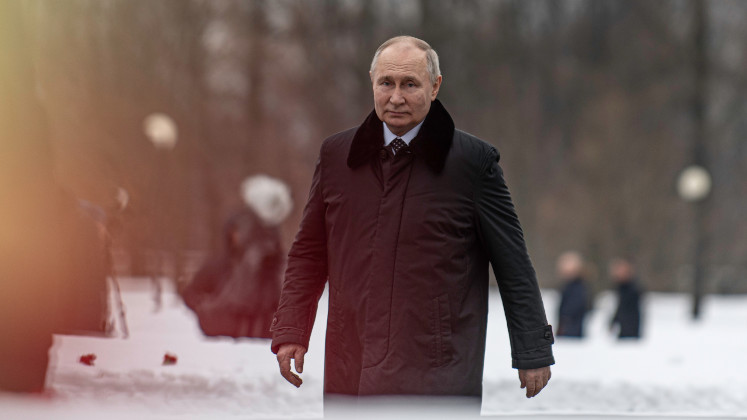
Then there is the conspicuous part: Vladimir Putin’s public absence and silence. The Kremlin has not issued an official response on its website regarding the situation in Venezuela, nor has Putin. This posture reveals a familiar pattern: delegating condemnation to diplomats while preserving caution at the presidential level.
The events in Venezuela come a little over a year after the fall of Bashar al-Assad, and in that situation, Putin’s posture was the same as the one we are witnessing in Venezuela. Back in October 2025, Maduro sent a plea to Putin urging him to send missiles, repair fighter jets, supply radar equipment and provide a financial plan to Caracas. It was not clear how Putin replied.
Certainly, Russia sent a new air-defence system and condemned the US decision to move military force in the Caribbean, but Putin remained quiet. Taken together, Putin’s silence since 2025 looks less like indifference and more like constraint – a way to avoid locking Russia into a commitment trap when Russia is neither able nor willing to pay the costs of a direct confrontation with the US. Putin’s most pressing priorities and vital interests lie far from Latin America and the Caribbean.
What are the strategic implications for Russia?
Latin America and the Caribbean are not homogenous regions for Russia, and Russia does not approach these regions as if they were. In practice, Russia has long treated Latin America and the Caribbean as a set of different clusters, engaging intensively with a small cluster of aligned governments while maintaining thinner, transactional or symbolic ties elsewhere.
Regarding Venezuela, since the early 2000s, the country has mattered to Russia and vice versa for more than rhetorical reasons. Hugo Chávez’s Venezuela acted as Moscow’s main gateway back into Latin America, using oil diplomacy, arm deals and anti-US alignment. In the past five to six years, Russia and Venezuela have reinforced that partnership, becoming a node for evading sanctions, with Russian state-linked energy stakes not only continuing under the sanctions but also adapting to them.
However, the situation has now drastically changed for this bilateral partnership. There are both short-term and long-term implications for Russia in Venezuela. The short-term implication is for Russians to adapt to a political reality that is now under pressure. Maduro’s removal left the same governing network in place, and the de facto leader is a figure closely associated with managing Venezuela’s external partnerships and major deals, including Russia. That continuity preserves an interlocutor.
However, Russia now has to test how long it can hold under an interim government that is simultaneously facing US demands to change the status quo. The same continuity that stabilises Russian exposure in the short-term also makes it easier for the United States to apply targeted pressure in the long-term, because Washington can identify and go after the main pressure points that keep Russia’s position alive, including personnel, contracts, payments, shipping, smuggling and access to black markets.
Russia and Venezuela’s oil sector
Washington’s three stages approach to Venezuela – stabilisation, access to Venezuela’s markets and transition – and the decision to start redirecting and marketing between 30 and 50 million Venezuelan barrels of crude introduces at least three long-term implications for Russia.
The first is a cashflow takeover that weakens Russia’s leverage inside Venezuela, because even if Russian contracts and joint ventures remain valid on paper, the practical question becomes whether Russia can monetise them without access to the revenue source.
The second is a shift from who owns what in Venezuela to who can actually move barrels and enforce rules at sea. US officials have been explicit and have already started taking steps to implement an oil embargo and control Venezuelan oil flows to drive change, and that implies enforcement against alternative marketing channels.
Here, legal warfare over assets could become a prolonged front. If the US reshapes Venezuela’s oil sector and revenue flows, the question is what will happen with Russia’s oil contracts, ventures and repayments.
Finally, there is a risk of a sustained drop in oil prices. If the US succeeds in bringing Venezuela’s backed-up crude and future production back onto the market, even gradually, a prolonged period of lower prices would translate into weaker inflows for Russia, tighter room for manoeuvre and higher vulnerability to an already sanctioned economy.
Russia’s presence in Latin America
Finally, the overall Russian presence in Latin America and the Caribbean are, to some extent, unchanged. Russia’s deals and partnerships with the rest of the region are unlikely to be altered overnight and remain marginal as they currently are. Yet, Russia’s operations and logistics in the Caribbean and its ties with close partners like Cuba and Nicaragua may face long-term adaptation pressures.
Some of these implications include a reduction in Russia’s credibility as a security partner, which will spill over to Cuba and Nicaragua. The operation in Venezuela is a reminder that Russia cannot deter a US military operation in the Western Hemisphere.
Russia may also lean more heavily into internal security relationships rather than a conventional military presence. If Washington pressures Caracas to expel foreign advisors, Russia’s next-best option is to protect its position through internal security channels, including in Cuba and Nicaragua.
Russia’s information operations in the Caribbean and the rest of Latin America are likely to become even more central because they are low-cost and scalable. Finally, if the US sustains interdictions, seizures and legal pressure at sea with or without the support of allies, Russia’s regional influence in the Caribbean is going to be contested and largely displaced.
Note: This article gives the views of the author, not the position of LSE European Politics or the London School of Economics.
Image credit: Kulinich Stepan provided by Shutterstock.





Discussion about this post