



















After years of stalled progress, EU enlargement is back on the agenda again in Brussels. Vera Spyrakou argues the success of future enlargement depends on maintaining strict democratic standards while implementing the reforms needed to sustain a widening Union.
EU enlargement has re-emerged as one of the defining political questions of the European Union’s future. Russia’s war against Ukraine fundamentally reshaped the geopolitical environment in which enlargement operates. This has transformed it from a largely procedural policy into a strategic instrument.
The question facing the EU today is not whether enlargement is desirable in abstract terms, but what it can realistically achieve and how it can strengthen rather than strain the European project. Answering this question requires reconciling strategic expansion, democratic conditionality and the EU’s relationship with the UK.
Enlargement is back on the agenda
Public opinion across the EU suggests that enlargement has regained legitimacy. The latest Eurobarometer figures indicate that most EU citizens support further enlargement, with particularly strong backing among younger Europeans.
Importantly, this support is not naïve. Citizens tend to endorse enlargement when it is framed as conditional, gradual and anchored in democratic reforms. Enlargement is thus perceived less as an act of generosity and more as a mutually reinforcing process that can enhance the Union’s geopolitical weight, economic resilience and normative credibility.
This shift in the public mood matters. European integration has always relied on a delicate equilibrium between elite-driven institutional design and popular consent. Enlargement in the 2000s was, to a significant extent, an elite project justified through the language of historical responsibility and post-Cold War reconciliation.
In contrast, enlargement in 2026 is debated in a more politically contested environment, shaped by democratic backsliding within some member states, fiscal pressures and concerns about governance capacity. The challenge now is to translate strategic urgency into institutional credibility.
Ukraine, Moldova and the Western Balkans
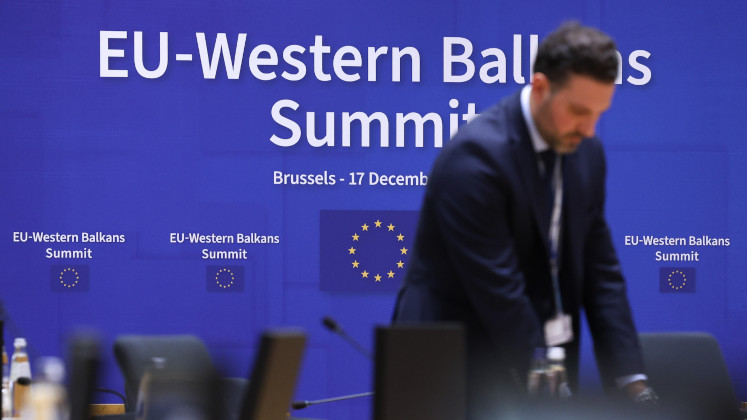
Ukraine, Moldova and several Western Balkan countries stand at different stages of accession, yet they share a common political reality: their European trajectory is inseparable from questions of democratic consolidation.
The war in Ukraine has elevated accession from a long-term aspiration to a symbol of civilisational alignment. For Kyiv and Chisinau, the European Union represents not only economic opportunity but also security, stability and democratic anchoring.
However, symbolic recognition cannot substitute for structural reform. The scale of transformation required in relation to judicial independence, anti-corruption frameworks, administrative capacity and regulatory alignment is immense. Accession cannot be accelerated to the point where conditionality becomes rhetorical.
For enlargement to succeed in 2026, conditionality must remain credible, but it must also evolve. The traditional model where progress is rewarded with incremental negotiation chapters has often produced reform fatigue and political stagnation. A more results-based approach is needed, one that connects concrete reforms with tangible benefits for candidate countries’ citizens.
Gradual integration into selected EU programmes, phased access to structural funds and participation in common policy frameworks can demonstrate that progress brings visible gains. At the same time, the EU must be prepared to reverse benefits in cases of democratic backsliding. Reversibility is not punitive – it is protective. It safeguards both the integrity of the accession process and the EU’s internal cohesion.
Enlargement and internal reform
Internal cohesion is the second pillar of a credible enlargement strategy. The EU’s 27 members already face difficulties in decision-making, particularly in areas requiring unanimity. Adding new members without institutional adaptation risks compounding existing dysfunctions.
Enlargement therefore cannot be separated from internal reform. The debate over qualified majority voting in foreign policy, the future of the EU budget and the institutional balance between large and small states must be confronted with renewed seriousness. Enlargement is not only about preparing candidates – it is equally about preparing the Union itself.
However, enlargement should not be framed solely through the lens of risk management. It is also a forward-looking identity project. The EU has historically defined itself as a community of law, democracy and shared sovereignty.
By offering membership to countries that commit to these principles under extraordinarily difficult circumstances, the EU reaffirms its foundational narrative. In an era of geopolitical fragmentation and democratic contestation, enlargement can serve as a statement of confidence in the transformative power of integration.
The UK question
This broader reflection inevitably brings us to the United Kingdom. Six years after Brexit formally took effect, the UK occupies an ambiguous position. It lies outside the EU’s institutions but is deeply interconnected with its economic and security architecture.
Public opinion in Britain has gradually shifted. Recent polling suggests that a consistent plurality, and in some surveys a majority, would now support re-joining the EU in a hypothetical referendum. While political realities in Westminster make immediate re-accession unlikely, the long-term trajectory of British public opinion cannot be dismissed.
The possibility of UK re-accession challenges simplistic narratives about enlargement as a one-directional process. Enlargement has traditionally been about the EU expanding outward. A British application would represent a different dynamic: reintegration after voluntary withdrawal.
It would raise complex institutional questions regarding budget contributions, opt-outs, regulatory alignment and the indivisibility of the four freedoms. The EU would need to decide whether a returning member state could negotiate special arrangements or whether accession conditions would apply uniformly.
From a normative standpoint, however, the more profound question concerns the nature of European co-belonging. If the EU presents itself as a voluntary association grounded in democratic choice, it must also remain open to reconsideration.
The credibility of enlargement depends not only on strict conditionality for candidates but also on the consistency of principles applied across cases. If Ukraine, Moldova or Serbia are asked to align fully with EU standards before accession, the same expectation would logically apply to the UK. There is no shortcut back to membership. But neither should there be a permanent closure of the door.
The UK debate also intersects with internal EU reform. A future enlargement round that includes Eastern European candidates alongside the theoretical prospect of British re-entry would intensify discussions about differentiated integration.
The Union already operates with varying degrees of participation across policy areas, as we have seen so far, from Schengen to the eurozone. Managing diversity while preserving unity has become a structural feature of European governance. The question today is whether this flexibility can be harnessed constructively, rather than perceived as fragmentation.
A credible pathway
Ultimately, what the EU needs is a credible pathway for enlargement. This means maintaining rigorous democratic conditionality while providing meaningful interim integration. It also means initiating serious internal reforms that anticipate expansion rather than react to it and articulating enlargement as part of a coherent geopolitical and normative strategy.
Enlargement is now less about numbers and more about direction. It is about whether the EU can reconcile strategic ambition with institutional prudence, and whether it can demonstrate that membership remains both demanding and transformative.
If managed with integrity, enlargement can strengthen the single market, enhance Europe’s global standing and deepen democratic resilience. If mishandled, it risks fuelling scepticism and institutional paralysis.
The European project has always evolved through moments of tension between widening and deepening. The current juncture is no different. The task before European leaders is not to choose between expansion and consolidation, but to align them. In doing so, they must remember that enlargement is ultimately a political act grounded in shared identity and democratic consent.
Whether in Kyiv, Chisinau, Belgrade or even London, the European question remains the same: what kind of Union do we want to build, and who can we become together?
Note: This article gives the views of the author, not the position of LSE European Politics or the London School of Economics.
Image credit: European Union.






Discussion about this post