
















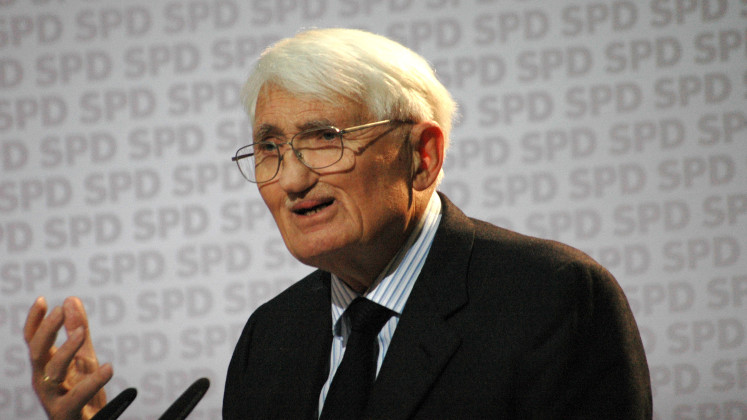
Jürgen Habermas, who died on 14 March, was one of Europe’s most influential thinkers. Reflecting on his work, Simon Glendinning revisits the argument Habermas made for establishing a supranational democracy in Europe.
Jürgen Habermas was perhaps the most prominent critical friend of the European Union. Throughout his life, he argued forcefully for the principle of European integration, but he was deeply critical of its execution.
In his view, the configuration of Europe should not be an international organisation dependent on finding ongoing agreement between sovereign nations. Rather, he called on the EU’s member states to take steps toward a supranational democracy: an international state which is formed by a fundamental “transfer of competences from the national to the European level”. A common government for Europe.
Habermas was unusually honest about the sea-change that this transfer implies. He hailed it as an overcoming of “national particularisms” and the “dethronement” of the European Council. He accepted that it would involve something more than we have ever seen before.
Not a further pooling of sovereignty over some policy field, not the further extension of Union competences permitted by treaties between nation states, but a “decision”, a sovereign decision on the part of each member state, to give up the power to make sovereign decisions.
As if to placate those concerned that something of importance might be imperilled in such a move, Habermas offered a new role for the old nations, writing that “nation states could well preserve their integrity as states within a supranational democracy by retaining the role of the implementing administration”.
Is there a third way?
Habermas was not so naïve as to think that this proposal would find wide popular support. But he did his best to omit the potential for a third alternative from consideration: one that rejects both the old Europe of nation states in endless bellicose rivalry and the renunciation of national sovereignty that would give birth to the new Europe he longed for.
Though he was careful not to spell it out in any detail, he did identify the basic conception of this third way when he recalled that Immanuel Kant had called for “a voluntary association of states willing to co-exist peacefully while nevertheless retaining their sovereignty”. However, having acknowledged the Kantian alternative, he immediately, and I think wholly unjustifiably, claimed that Kant conceived this only as “a transitional stage” en route to an international state. Habermas called this supposedly transitional stage “weak”, “conceptually flawed” and “sterile”.
I suspect exactly the opposite is true. Kant’s carefully defended idea of a “negative substitute” for an international state is in no way improved on by what Habermas called “the fortuitous hindsight of later generations”. On the contrary, it is totally misunderstood, and “overcoming” it, as Habermas demanded, is not only unfaithful to Kant, but would, if it were ever realised, likely lead to disaster for Europe.
What perhaps seduced Habermas into thinking that the idea of a negative substitute (the voluntary association of states) was a transitional stage for Kant, is Kant’s remark that, if the aim is to eliminate war, “the only rational step” would be the formation of an international state.
But Kant did not think this step would be ruled out only for a period of time: he thought that this step required something of states that is not (contingently) unlikely or hard to bear at present but (conceptually) strictly nonsensical.
It makes no sense, if we are dealing with nation states, to suppose there could be a “decision” that would be the willed act of giving up the will to act. Suicidal self-sacrifice is not the sort of thing a nation state (as long as it is a nation state) can intelligibly will.
It is for this reason that Kant insisted that “the positive idea” of an international state of the sort Habermas called for “cannot be realised”. So he did not call for a transitional institution but an “enduring” negative substitute, and hence a strikingly paradoxical conclusion: this substitute, while falling short of the “rational ideal” that would eliminate war could not, in fact, be bettered. While it can only make war less likely, it is better than the ideal. And it is better because it is not only desirable but possible.
Hegemony and solidarity
But isn’t the federalist dream of a supranational democracy possible too? Couldn’t it come about? Yes, it could – but not in virtue of a decision that would be “the will of the nations”. How then? We must ask: who could will it into being?
If nations cannot will it into being, perhaps some other thing could. For example, nations-in-ruins could will it. Perhaps something at the other end of the scale could will it too: a nation that is strong enough to see its own interests coinciding with the interests of the emerging European “supranational democracy”. In this case, it would be implementing and administering at the national level what it would in any case will for itself were it an autonomous sovereign power. It would be a quasi-hegemonic power.
Habermas made his case for a supranational democracy at the height of the Eurozone crisis. It is perhaps not altogether accidental that he concluded his discussion with the acknowledgement that, with regard to “the fate of the European Union”, “the German government… holds the key… in its hand”.
Habermas intended this to point towards the very opposite of an imperial or hegemonic act. Driving the movement towards a supranational democracy would be, he claimed, a supreme act of “solidarity” to nations in peril – an act of penance for the “moral catastrophe” of Nazism and a way of finally putting an end to German desires for “a fatal ‘semi-hegemonic’ status in Europe”.
I have already indicated that a quasi-hegemonic position is not in the least ruled out in the formation of an international state. But I think one should also baulk at his conception of German agency in the European context as an act of “solidarity”. Indeed, it could no more be an act of international solidarity than the formation of an international state could be the will of the nations.
Solidarity, as Habermas more or less appreciated, belongs historically to a politics of friendship or “fraternity”: of standing shoulder to shoulder with one’s “brother” in need. The term is, of course, part of the lexicon of socialist calls for collective action. But it is also used, and politically speaking more broadly used, in the international arena, where we often see calls for solidarity between states, for example in the aftermath of famine or flood.
However, the act of (supposed) solidarity that Habermas sought is radically discontinuous with both of these traditions. To use the very words that Kant used when he appealed to the idea of a European Union over 200 years ago, the point of an act of solidarity is to help “preserve and secure” the other from disappearance or annihilation. In international terms, to preserve and secure the state status of a state: not to submerge it in a tsunami of political overcoming.
An enduring multiplicity
A fast-track to Eurofederalism is not the only alternative for Europe: a voluntary league of nations remains not weak, conceptually flawed and sterile but our greatest opportunity for making war in Europe less likely and allowing “our part of the world” to flourish.
But to appreciate this, we need to acknowledge that the movement towards “ever increasing union between the peoples [sic] of Europe” does not require us to build a new singularity but an enduring multiplicity. J.S Mill, like Kant before him and Paul Valéry after him, was clear that this alone is the source of Europe’s productive power:
What has hitherto preserved Europe from [becoming a stationary culture rather than a progressive one]? Not any superior excellence in the [European family], which, when it exists, exists as the effect not as the cause; but their remarkable diversity of character and culture. Individuals, classes, nations, have been extremely unlike each other: they have struck out a great variety of paths, each leading to something valuable; and although at every period those who travelled in different paths have been extremely intolerant of one another, and each would have thought it an excellent thing if all the rest could have been compelled to travel his road, their attempts to thwart each other’s development have rarely had any permanent success, and each has in time endured to receive the good which the others have offered. Europe is, in my judgement, wholly indebted to this plurality of paths for its progressive and many-sided development.
A European Union that could both “preserve and secure” this diversity and simultaneously institute conditions of increasing international tolerance “likely to prevent war” is not a weak idea: it is a great idea.
Note: This article gives the views of the author, not the position of LSE European Politics or the London School of Economics.
Image credit: 360b provided by Shutterstock.







Discussion about this post