

















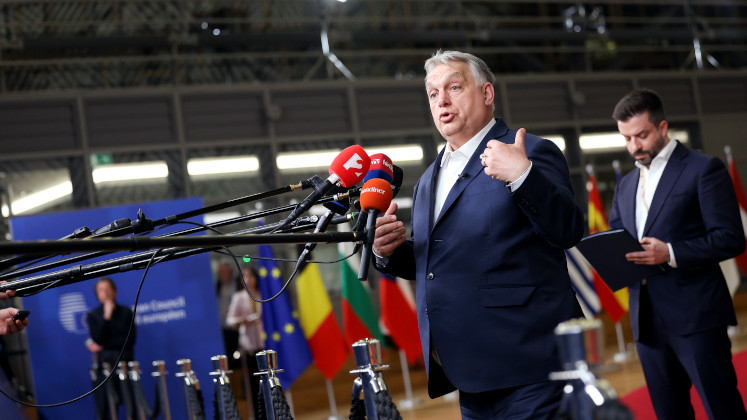
Viktor Orbán’s defeat in Hungary has deprived illiberalism of one of its central figures. Zsolt Enyedi argues the world will now be watching to see if Péter Magyar can establish the constraints on executive power that were so conspicuously absent during the Orbán era.
The landslide victory of Péter Magyar’s party, Tisza, has brought the Orbán regime to an end in a manner that surprised many observers. The electoral defeat was larger, and the transition of power appears to be smoother, than expected. A simple absolute majority would likely have led to a Polish-style struggle among state institutions, but Tisza’s supermajority allows for a clean slate.
The result is particularly striking given the uneven distribution of resources. According to available data, right before Meta stopped accepting political ads in October 2025, Fidesz and its affiliated organisations outspent not only all other European political actors but also most European countries, even though the election was still more than six months away.
By contrast, Tisza was not only significantly poorer but also largely excluded from public media and treated with visceral hostility. Considerable attention was devoted, for example, to critically evaluating a so-called “Tisza manifesto”, despite the party having nothing to do with the document.
The international consequences of the Hungarian elections may be substantial. The intellectual infrastructure of illiberalism benefited greatly from Orbán. Timothy Snyder may have overstated the case when he described Orbán as the sun in the solar system of MAGA, but there is little doubt that many illiberal actors drew inspiration from the apparent success of building and sustaining an intolerant conservative regime in the heart of Europe.
While there is no immediate reason to expect Trump, the AfD or Chega to suffer electoral setbacks in the short run, longer-term effects are conceivable. Modern illiberalism relies on democratic rhetoric; it requires demonstrable popular support. In Hungary, support from Putin or Trump was present, and resources were abundant – but, ultimately, the people were not.
Why Fidesz lost
The most important structural reason for the debacle was the lack of economic growth. Between 2013 and 2019, the Hungarian economy experienced several strong years, but thereafter investment slowed and EU transfers gradually stopped coming. Both developments were closely linked to persistent deficiencies in transparency, fair competition and the rule of law.
The second major factor was the replacement of a fragmented opposition by a single, unified party. As early as the mid-2010s, opposition elites recognised that the electoral system redesigned by Fidesz penalised fragmentation, yet the quarrelsome cluster of minor parties failed to consolidate into a credible alternative. The eventual solution was the near-complete replacement of the established opposition parties by Tisza, a genuine newcomer.
A third factor was a series of scandals beginning in 2024. Fidesz had long employed a moralistic discourse against both the opposition and sexual minorities. When it emerged that senior officials had covered up cases of child abuse, the regime’s hypocrisy became starkly apparent.
A fourth element was sheer longevity. Hungarians grew tired of Orbán. Somewhat more unexpectedly, Orbán also appeared to grow tired of Hungary. Assuming his position to be secure, he devoted increasing attention to international politics in recent years.
This misplaced focus became particularly evident during the 2026 campaign. While Péter Magyar emphasised a robust domestic agenda – healthcare, transportation, corruption, media freedom – Orbán framed the election as part of a global confrontation between himself and his allies (Trump, Le Pen, Fico, among others) on one side, and his adversaries – von der Leyen, Zelensky, Manfred Weber and “woke global elites” – on the other.
This discourse was not only detached from everyday concerns but also increasingly extreme. He suggested, for instance, that a defeat would allow Zelensky to form a government in Budapest and claimed that Hungarians would be sent to die on the Russian front if he were no longer in power. The Budapest speech of JD Vance, in which he complained about activists who throw fake blood on precious artworks, further underscored the discrepancy between domestic demand and the offer.
Finally, Orbán clearly underestimated Magyar. This is understandable: as a lower-ranking public official and the husband of one of Orbán’s ministers, originally Magyar was merely a sergeant in an army commanded by the field marshal, Viktor Orbán himself. Orbán could scarcely imagine that someone of such status – without electoral experience and without the backing of the traditional left – could mount a serious challenge.
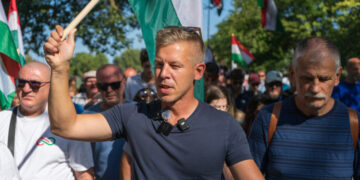
Yet Magyar proved to be an effective campaigner, visiting some 600-700 settlements, withstanding relentless government attacks and maintaining strict message discipline by avoiding controversial topics. He built a vast following on social media and addressed citizens directly, circumventing pro-government media.
Magyar’s policy profile
Magyar draws support from moderate right-wing voters in provincial towns and smaller settlements, as well as from urban liberals and left-wing voters who view him as a liberating figure after years of perceived domination by an authoritarian force.
He is able to hold this coalition together not only by focusing on practical issues, but also by presenting the West as a shared point of identification – understood as a cultural and historical community to which Hungary has belonged since the end of the first millennium. Liberals and left-wing voters read into this vision tolerance and diversity, while conservatives associate it with Christian values and law and order. Potential tensions are thus temporarily muted.
He is likely to lead a pragmatic, centre-right government, showing more continuity with Orbán’s policies than many of his supporters wish. Magyar is unlikely to position himself at the forefront of European efforts to confront Trump or Putin or to deepen EU integration, and he may occasionally even resist such initiatives.
He is expected to take a firm stance on asylum policy, though without the Orbán-style hate campaigns against immigrants. His programme envisions a shift from a politically controlled, rent-seeking system toward a more rules-based economy, combined with moderate redistribution and public investment. He expects significant resources to be freed through dismantling state capture and oligarchic networks, increasing transparency in public procurement and unlocking EU funds.
He has also signalled an intention to move toward eurozone criteria and adopt the euro as soon as feasible. He promised a wealth tax that applies to a tiny segment of society, but has not yet committed to a major reform of the flat personal income tax-regime. Finally, he appears inclined to maintain Orbán’s generous family benefits.
The chances of renewal
Ironically, Magyar inherits from Orbán a system that allows for rapid and far-reaching reform. He can fire civil servants at will and can turn the public media discourse into its opposite with a switch.
Pro-government media outlets, lacking a sustainable business model outside state support, may struggle in opposition. By contrast, independent and liberal media have expanded significantly in recent years, often relying on crowdfunding. The judiciary remained relatively resilient, with political influence largely concentrated at the top levels.
Orbán retains the talent, networks and financial resources to attempt to reinstate his rule. But Hungarian governments are among the most stable in Europe, meaning he would likely have to wait at least four years. Moreover, after two decades in office, public appetite for his return appears limited. Still, he may seek to remain politically active – not least to protect allies and family members who could face legal scrutiny.
The most serious challenge to Hungarian democracy, however, may come not from Orbán but from Magyar. This is not due to any overtly undemocratic inclinations, but rather to the temptations inherent in holding a constitutional supermajority. In the short term, such a majority facilitates decisive reform; in the long term, however, it is unhealthy for a system in which elections repeatedly produce overwhelming dominance.
Magyar will therefore need to reform institutions in a way that makes such sweeping victories less likely in the future. The key question for democracy is whether he is willing to establish the constraints that were so conspicuously absent during the Orbán era.
Note: This article gives the views of the author, not the position of LSE European Politics or the London School of Economics.
Image credit: European Union.






Discussion about this post