












The Eurovision Song Contest sets world-leading standards in performance design and has helped launch the careers of many creative professionals. Yet as Catherine Baker explains, questions of ethics and politics are likely to weigh more heavily on this year’s contest than technology, music and design.
Seventy years ago, the European Broadcasting Union launched its own international song contest so that its member broadcasters could experiment with the ground-breaking live link-ups facilitated by the EBU’s new Eurovision Network. Today, when the innovations of the 1950s seem routine, where the Eurovision Song Contest sets world-class standards for television production is its performance design.
Launching careers
Eurovision’s reputation among creative professionals like those who contributed interviews to a volume I recently co-edited with scenography expert Amy Skinner, is such that when an invitation to work on the contest materialises, designers usually jump at the chance.
Some develop ongoing business relationships with the event, like UK lighting designer Tim Routledge, who first worked on Eurovision in 2023 when the BBC and Liverpool hosted the contest on Ukraine’s behalf. He was then rehired by the Swiss and Austrian host broadcasters in 2025–26: his lighting concept for the seventieth anniversary contest in Vienna will make it the first show of this scale to be lit entirely by LED and laser systems rather than traditional, less sustainable studio lights.
Just as the contest has given peripheralised countries in Europe a platform for breaking their culture through into international public consciousness, it can also be a launchpad for creative careers behind the scenes. Perhaps the most spectacular story belongs to young Spanish art director Sergio Jaen, who staged the immersive “Doomsday Blue” for Ireland’s non-binary alternative musician and practising witch Bambie Thug in 2024, a year after graduating from the London College of Communication.
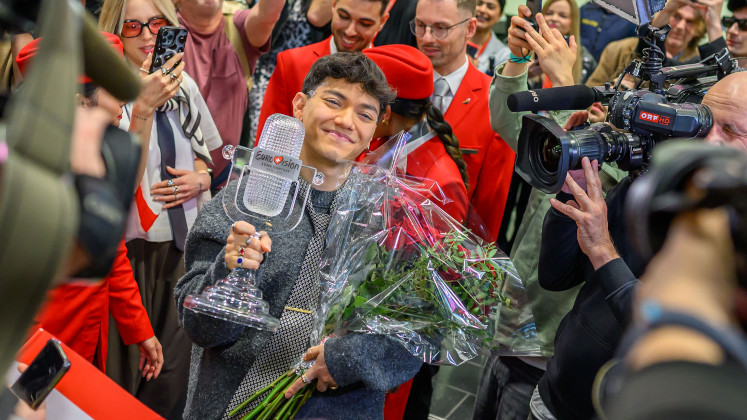
Their sensational performance brought 22-year-old Jaen invitations to stage three broadcasters’ entries in 2025, including countertenor JJ’s Austrian winner “Wasted Love”, and a standing role with Finland’s broadcaster YLE to design all the entries in its ambitious national selection UMK, including this year’s current favourite to win Eurovision – Linda Lampenius and Pete Parkkonen’s intense “Liekenheitin” (“Flamethrower”), staged in the wreckage of a burning orchestra.
Europe’s Super Bowl
Today’s song contest both presents itself as Europe’s answer to transatlantic televised musical spectacles like major awards shows or Super Bowl interval acts and confronts designers with unique logistical challenges. Every prop, as large as the “panini press” from which Sweden’s Loreen won her second contest in 2023 or as heavy as that year’s Australian band’s full-size sports car, must be moved on and off stage within the forty seconds it takes to show each entry’s introductory postcard film.
Besides the host broadcaster, more than thirty competing broadcasters and their creative teams have input into what will appear on screen. And the event’s competitive function means that even though better-funded broadcasters are more able to invest in high-end staging for their entries, the host’s underlying stage design must offer all entrants a baseline level of fairness – a point of contention in 2022 when several delegations had to redesign their visuals after the Italian host broadcaster’s on-stage lighting rig failed to rotate as planned.
Eurovision’s status as an international competition also thrusts the EBU, an institution that largely exists to support its member broadcasters to exchange technological innovation and manage relationships with government, into the equivalent role that governing bodies like the International Olympic Committee or FIFA play for sports mega-events – with all the geopolitical challenges that brings.
But unlike FIFA or the IOC, which operate autonomously and unaccountably in the international sphere, the EBU is composed of member broadcasters which are independent from, yet politically answerable to, national governments. Whether such an organisation is equipped to manage contexts as contentious as the controversy over Israel’s participation, now in its third year, is an increasingly open question, and this year’s contest will have the smallest number of entries since Eurovision became a multi-night event.
Eurovision boycotts
Debates over how Eurovision might enable states committing human rights abuses to launder their international image are nothing new. In the 2010s they primarily concerned Russia, whose broadcasters commissioned some of the contest’s most technologically advanced production design while the Russian state was already waging the first phase of its war on Ukraine.
This continued until Russia’s full-scale invasion made nine Baltic, Nordic and central European EBU members threaten to boycott Eurovision 2022 unless the Russian broadcasters were expelled.
Marco Biasioli has termed the period’s Russian entries a strategy of “songwashing” that leveraged Eurovision’s festive appeal to present Russia as a peaceful, creative and diverse state – including 2016’s and 2019’s ground-breaking interactive digital performances by Sergey Lazarev, a singer whom Russian gay men often regarded as one of their own.
While widespread public consensus over solidarity with Ukraine in Eurovision’s participating countries infused the 2022 and 2023 contests’ emotive atmosphere, the overarching geopolitical narrative surrounding Eurovision since 2024 falls on ground where European publics – and their governments – could scarcely be more divided.
Nor could the EBU’s membership: the scandal over Israeli state-sponsored advertising urging supporters to vote for Israel the maximum permissible number of times, as documented by the EBU’s own newsroom fact-checking service, fractured five broadcasters’ trust in the organisers’ ability to guarantee fair competition so badly that Spain, Iceland, Ireland, Slovenia and the Netherlands will not participate in Eurovision 2026.
Ethics and politics
Some of those who most identified with Eurovision’s playful celebrations of queerness and nationhood in the years when Conchita Wurst became its icon have since walked back their attachments to the event.
Bambie Thug, one of several contestants in 2024 who wanted to express solidarity with Palestine and were dismayed by how the EBU managed the backstage environment, no longer performs their Eurovision song. Nemo, that contest’s non-binary winner, returned their trophy to the EBU in 2025 after a majority of members adopted limited voting reforms that meant Israel’s broadcaster KAN would still participate.
For the creative professionals who work on the contest and dedicate themselves to achieving world-leading production standards year after year, Eurovision is still business as usual. But for many others in the communities and publics orbiting the event, Eurovision’s seventieth anniversary is a year where questions of ethics and politics weigh more heavily than technology, music and design.
Catherine Baker is co-editor (with Amy Skinner) of Designing Eurovision: Performance Scenography on an International Stage (Routledge, 2026).
Note: This article gives the views of the author, not the position of LSE European Politics or the London School of Economics.
Image credit: Simlinger provided by Shutterstock.




Discussion about this post