






















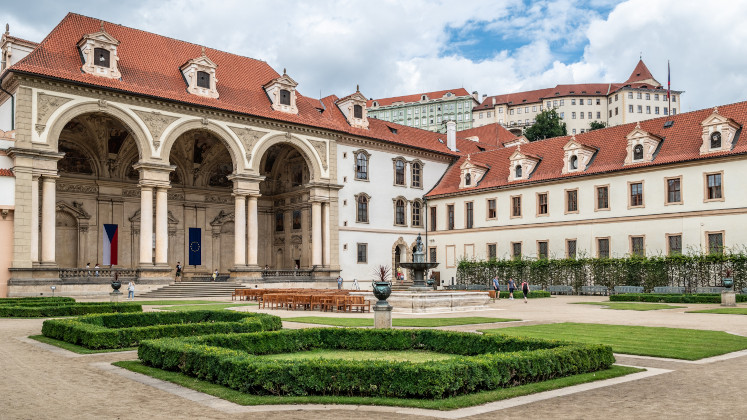
Compared with other Central and Eastern European countries, the Czech Republic has proved remarkably resilient to democratic backsliding. Drawing on interviews with senators, Jan Hruška and Seán Hanley explain how the Czech Senate’s self-perception as a “guardian of democracy” allows it to act as a vital institutional brake on illiberal reforms.
Over the past decade, Central and Eastern Europe has become a focal point for studies on democratic backsliding. In countries like Poland and Hungary, elected populist leaders successfully dismantled liberal checks and balances through “executive aggrandisement” – a process of slowly stripping away institutional constraints.
The Czech Republic appeared to be following a similar path after the 2017 election of billionaire populist Andrej Babiš, who campaigned on a platform that included proposals to drastically centralise the constitutional system. Once in office, he worked in concert with Czechia’s then President Miloš Zeman, who repeatedly sought to aggrandise his powers as head of state by bypassing or ignoring constitutional norms.
However, unlike its neighbours, the Czech Republic did not experience a major democratic erosion. While mass civic mobilisation and well-coordinated opposition coalitions played their part in thwarting Babiš, who subsequently lost power in the 2021 elections, a key (and often overlooked) factor in this resilience was the role of the country’s upper house of parliament, the Senate.
With Babiš now back in power at the head of an illiberal coalition including two previously marginalised right-wing populist parties, this unsuspected source of democratic resilience may be tested again.
An asymmetrical but essential brake
Like many European democracies, the Czech Republic operates an asymmetrical parliamentary system where the lower house (the Chamber of Deputies) holds the majority of legislative power.
In most ordinary matters, the Czech Senate – created as a new institution when the Czech Republic was founded in 1993 – has only weak powers. It can delay legislation, but its veto can be easily overridden by a simple majority in the lower house.
However, it also has crucial “hard” powers that cannot be overruled. The Senate’s consent is required for any changes to the Constitution or the electoral law, and it must approve (and can block) the President’s nominees for the Constitutional Court.
In the context of potential backsliding, this means that even a government with a huge majority in the lower house cannot rewrite the rules of the democratic game – redrawing electoral boundaries or curbing the powers of the judiciary – as happened in unicameral systems like Hungary or Slovakia.
In some European democracies, upper chambers can be easily bypassed or simply mirror the composition of the lower house. But the Czech Senate’s design makes it a formidable gatekeeper.
It cannot be dissolved and has a staggered electoral cycle, with one-third of Senators coming up for re-election every two years. It has proved difficult for governing parties to win control of. Single-member districts and second-round run-off elections favour independents (and moderates) more than big national parties, which often lack a strong local presence.
Internal legitimacy is vital
However, for an upper house to be an effective source of resilience, it needs more than just robust and clever institutional design. Its members must feel they can and should use their powers. This is a crucial point because upper houses often face legitimacy problems, and the Czech Senate is no exception, historically struggling with low levels of public trust and criticism that it is a pointless surplus institution.
Our research, based on semi-structured interviews with senators, suggests that the Czech Senate’s resilience stems from “internal legitimacy” – how the senators perceive themselves. Regardless of public opinion, Czech senators across the political spectrum view themselves as a “guardian” or “shield” of democracy.
This self-perception was partially rooted in the Senate’s electoral system. The two-round majoritarian system in single-member districts gives senators a sense of a personal, independent mandate that feels distinct from the party-list system of the lower house.
This “internal legitimacy” is vital. Even if the public is indifferent, the Senate’s members must feel legitimate enough to act as a veto player and block a governing majority in the interest of constitutional stability. Without this deep-seated belief in their role, the Senate’s formal powers might remain unused in a crisis.
This identity has allowed the Senate to act as more than just a legislative hurdle. It has become a symbolic voice for democratic values. During the first (2017-2021) Babiš government, the Senate functioned as a high-profile forum for opposition and a source of independent scrutiny, providing a platform for resisting executive overreach.
By acting as a “voice” for the constitutional order, the Senate lent institutional weight to citizens concerned about the direction of the country, who have repeatedly taken to the streets and squares to push back against Babiš’s illiberal governance. In doing so, it showed that the executive was not the sole legitimate representative of the people at a time when both the presidency and the lower house were in the hands of illiberal populists.
Recipe for resilience
The experience of the Czech Senate suggests that the form of bicameralism and its exact configuration matter if an upper house is to serve as a source of democratic resilience.
We identify three essential components for this that must work in tandem. The first is formal powers. While the upper house does not need to be “strong” across all areas, it must have some “hard” powers where it cannot be overruled, specifically over the constitutional framework and electoral rules.
The second is independent behaviour. The upper house must show some degree of autonomy from the executive-dominated lower house. This can be facilitated by different electoral cycles or an electoral system that encourages individual, not party, accountability.
Finally, there needs to be adequate self-perception. Crucially, members of an upper house must believe they have both a mandate – constitutional or electoral – and a duty to act as a check on power. Without this “guardian” identity, even the strongest formal powers may remain unused in the face of political pressure or self-doubt.
Lessons for democracy
The Czech case has wider lessons for the politics of democratic resilience. It shows that well-designed upper houses can serve as a powerful counterweight to executive overreach. The Czech Senate’s resilience was not just a product of formal constitutional provision. It was a result of how those rules were inhabited by political actors who saw themselves as responsible for the survival of the democratic system.
In an era where many liberal democratic institutions are under strain, the Czech Senate provides a compelling example of how institutional identity coupled with specific veto powers can protect and bolster liberal constitutionalism against a rising tide of backsliding. With illiberal populist parties coming increasingly close to power in several major Western European democracies, it is perhaps time to reappraise upper houses elsewhere.
For more information, see the authors’ accompanying paper in Democratization.
Note: This article gives the views of the authors, not the position of LSE European Politics or the London School of Economics.
Image credit: Mirko Kuzmanovic provided by Shutterstock.




Discussion about this post