



















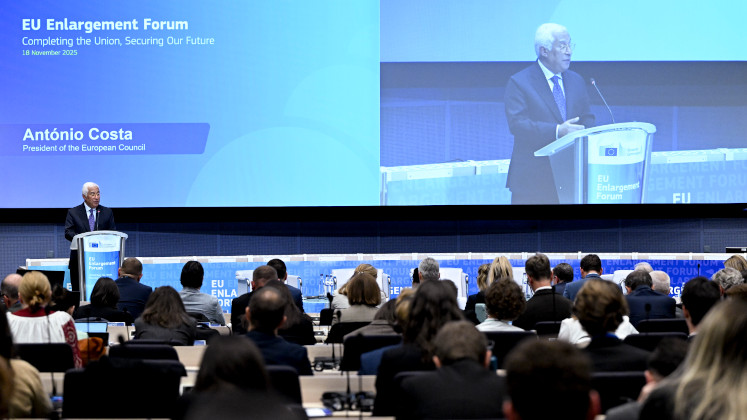
EU leaders will discuss enlargement at the European Council meeting on 18-19 December. Paul Schmidt argues that while the geopolitical case for enlargement is clear, the bloc must prioritise internal structural reform to avoid paralysis in a larger Union.
For foreign and security policy experts, the goal and direction of enlarging the European Union appear obvious: the EU must expand to include the Western Balkans, Ukraine and Moldova without further delay.
This is an ambition that has been stated for years. Its rationale is well-established: failure to stabilise and integrate the EU’s immediate neighbourhood risks leaving it open to the influence of rival powers, potentially with damaging democratic and geopolitical consequences that would not stop at our borders. Geography alone makes the case: the Western Balkans are already surrounded by EU member states.
The case for enlargement
Austria is one of those EU members that has consistently supported the accession of the six Western Balkan countries for well over two decades. The Austrian public, however, remains notably hesitant. Many regard the EU’s internal problems as the more pressing concern. Grand geopolitical visions, perceived as rather abstract for ordinary people, rarely resonate with voters facing more tangible, day-to-day challenges.
And despite frequent references to the need for more public engagement and political dialogue with civil society, there remains significant room for improvement. This is especially true in countries like Austria, where the EU, as is the case in many other member states, has long been mistreated as a scapegoat for everything that does not work and as an easy target for domestic political frustration.
The EU is not structurally prepared for enlargement
Still, one key issue of criticism clearly stands out: the EU in its present form is not structurally prepared for another wave of enlargement. Internal reform is essential if the bloc is to remain functional and coherent. Yet the necessary, and maybe cumbersome, reforms designed to make decision-making more effective and the Union more resilient are often deferred.
A glance at history is telling. When Austria, Sweden and Finland – and also Norway – signed their EU accession treaties at the European Council meeting in Corfu in June 1994, a reflection group was immediately tasked with considering institutional reform to prepare for the next round of enlargement, which then took place ten years later. The initiative laid the groundwork for agreements regarding weighted voting, thresholds for qualified majority decisions in the Council and the idea – still unfulfilled – of reducing the size of the European Commission.
Amidst the current international turmoil, such strategic foresight seems to be lacking today. Instead, the debate is dominated by makeshift proposals, such as temporarily restricting new members’ veto powers – an inadequate substitute for broader changes to qualified majority voting.
The rule of law mechanism currently in place, which permits the suspension of EU funds in the event of legal breaches, has also had limited effectiveness. If one day net contributors – or worse, several states simultaneously – were to be targeted by this mechanism, the backlash could seriously undermine cohesion within the Union.
A more consistent approach might involve giving the European Court of Justice the authority to suspend voting rights for member states that persistently disregard fundamental EU rules and regulations until such breaches are addressed.
Similarly, it is worth asking whether every member state still requires its own judge with full voting powers on the European Court. Alternatives, such as voting constituencies used by the European Investment Bank or rotation systems like the one employed by the European Central Bank, deserve serious consideration.
Reform must come first
Given that most candidate countries are relatively small, it would also be a good time to re-examine the EU’s internal balance of power, particularly the weighting of votes in the Council and the allocation of seats in the European Parliament. At present, smaller countries are deliberately overrepresented. Any further expansion will make a fairer distribution of parliamentary representation unavoidable.
The EU budget is also not ready for the times we live in and continues to present a familiar source of friction. Groundhog day is back as negotiations are currently taking place on the next EU medium term financial framework and tensions are once again surfacing between net contributors and net recipients, despite the total budget accounting for slightly over 1% of the EU’s gross national income.
It is difficult to see how such debates can remain manageable as the Union grows to 30 or more members. Sustainable solutions – such as EU-own revenue sources or, however controversial, the extended possibility of joint borrowing – must at least be on the table.
The obvious question remains: do we want a stronger, more capable and more independent Europe or one paralysed by indecision and overreach? The EU requires structural reform, not just ambition, if it is to manage future enlargements effectively. That work must come first.
Note: This article gives the views of the author, not the position of LSE European Politics or the London School of Economics.
Image credit: European Union







Discussion about this post