















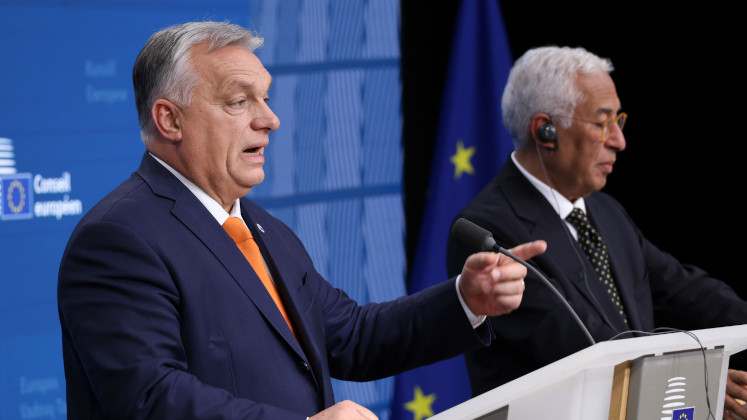
EU leaders will consider key issues such as financing Ukraine, future enlargement and the next EU budget at the beginning of 2026. But could Hungary’s Viktor Orbán derail the discussions? Mareike Kleine and Lucas Schramm show that whether the European Council will tolerate obstructive behaviour depends not on EU treaty rules, but on how politically costly it becomes for leaders domestically.
When EU leaders reconvene in Brussels early next year to discuss long-term financial support for Ukraine, enlargement preparations and the future of the EU budget, one question will hover over the agenda: has the European Council finally learned how to deal with serial norm-breakers?
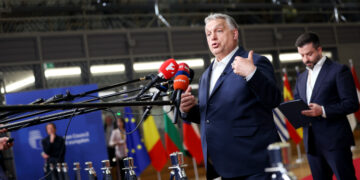
At the December 2023 and February 2024 summits, Hungary’s Prime Minister Viktor Orbán repeatedly threatened to derail decisions on Ukraine, only to back down at the last minute, leaving the room so that the other 26 leaders could adopt conclusions in his absence.
It was an extraordinary manoeuvre in a body where consensus is ritualised and public confrontation is normally avoided. Yet the real puzzle is not that Orbán was sidelined, but that it took years of obstruction for other leaders to respond with anything approaching collective resolve.
In a new study, we show why this moment matters. The European Council rests on an informal rule of diffuse reciprocity: a shared expectation that leaders will show goodwill toward each other when domestic politics tighten, and refrain from stoking domestic opposition when a compromise is in reach. This unwritten norm is what allows leaders to reach agreement even when every one of them holds a veto. But as we show, the norm is enforced only when its violation becomes politically costly at home.
The invisible rule holding the Council together
Diffuse reciprocity is not a legal principle. It is more like the etiquette of an exclusive political club. Leaders extend goodwill to one another today because they expect to need it tomorrow. They avoid leveraging domestic party battles for tactical gain and help each other package EU compromises for domestic audiences.
But because this norm is informal and ambiguous, it is vulnerable. There is no referee, there is no legal recourse. A leader who wants to exaggerate domestic pressures or weaponise unanimity can do so. That is, until other leaders decide that the political costs of tolerating such behaviour have become too high.
When leaders exploit goodwill – Cameron’s failed renegotiation
Orbán is not the first to test the European Council’s limits. One notable example of a leader pushing the boundaries of this norm is David Cameron when he tried to renegotiate the UK’s membership terms ahead of the 2016 Brexit referendum. His increasingly sharp rhetoric on freedom of movement and “ever closer union” was transparent to his EU counterparts, who understood that he was inflating domestic constraints partly of his own making.
Still, EU leaders did not push back initially. What changed was not so much the substance of Cameron’s demands as the sharp spike in negative media attention in France and Germany, where newspapers framed his tactics as unfair, destabilising and tantamount to blackmail. Under that spotlight, leaders, including natural allies like Germany and Poland, closed ranks. Cameron returned home with a largely symbolic package he could not sell domestically. In short: he overplayed his hand and the reciprocity norm held.
When leaders withhold goodwill – Orbán’s protracted veto politics
Orbán’s case is the mirror image, but also more troubling. For over a decade, he gradually shifted from occasional dissent to systematic obstruction, vetoing sanctions, blocking financial assistance to Ukraine and using budget negotiations as leverage to secure unrelated concessions, particularly the release of frozen EU funds.
For years, other leaders tiptoed around him. Even after Russia’s full-scale invasion of Ukraine, when unity was crucial, Orbán’s veto threats were often indulged. The European Council sought to accommodate him, fearing that open confrontation would fracture the Union during a geopolitical crisis.
But this long tolerance came at a price. Orbán learned that defiance paid off and pushed further. What ultimately changed was again not the substance of his demands, but the visibility of the obstruction and its political cost for other leaders. By late 2023, his tactics had become a staple of political coverage across Europe. Media narratives shifted from irritation to alarm, portraying Hungary not as an awkward partner but as an active spoiler.
This time, Orbán misjudged the politics. He withheld goodwill on a crucial and salient issue (Ukraine’s survival) that had become a moral and geopolitical touchstone across Europe. By tying EU unity to his own domestic political battles, he crossed a line that leaders could no longer defend at home.
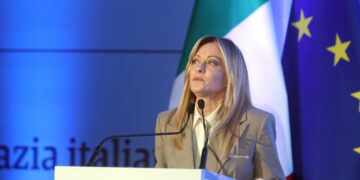
The result was a dramatic hardening of the EU’s stance: open threats to bypass Hungary’s veto, unprecedented discussions about potential reprisals, and coordinated pressure from all sides, including ideologically close leaders including Italy’s Giorgia Meloni. When the February 2024 summit opened, Orbán dropped his veto before negotiations even began. He had overplayed his hand and the reciprocity norm, finally, was enforced.
Why this matters for the next European Council meetings
The European Council will soon face another set of decisions with high domestic resonance: long-term Ukraine financing, enlargement to Ukraine and the Western Balkans, and reforms to the EU’s budget and decision-making rules.
The same dilemma will recur: should leaders accommodate domestic politics in one member state for the sake of unity or defend the norm that makes collective decision-making possible? Three lessons from our research speak directly to the months ahead:
First, enforcement remains political, not principled. The European Council did not suddenly discover that Orbán was undermining EU unity. It reacted only when his behaviour became impossible to justify domestically.
Second, when violations go unchallenged, the norm inevitably frays. Informal rules only hold if they are reinforced in the face of violations. Years of looking the other way at Orbán’s obstruction weakened the expectation of mutual goodwill and risked encouraging others to test the limits as well.
And without this shared understanding, decision-making in the European Council will become far harder at a time of unprecedented challenges for Europe, as negotiations slide more easily into veto threats and brinkmanship.
Third, Orbán’s leverage is diminished but not gone. He has fewer allies, less room to claim domestic necessity and has been burned by overplaying his hand. But unanimity still gives him leverage and future crises may again test others’ willingness to confront him.
With few allies left inside the European Council, Orbán may increasingly look beyond Europe for political backing, as illustrated by his recent visit to the White House to meet with President Trump. Whether this strategy pays off is far from clear, not least because of Trump’s volatility and Orbán’s pursuit of Chinese investment and Russian oil, both of which sit uneasily with the administration’s foreign-policy agenda.
The paradox endures: the informality that makes the European Council effective also leaves it exposed to exploitation. Whether diffuse reciprocity survives the next round of European Council negotiations will depend not on EU treaty rules, but on how politically costly it becomes for leaders to tolerate obstructive behaviour in their midst.
For more information, see the authors’ new study in the Journal of European Public Policy.
Note: This article gives the views of the author, not the position of LSE European Politics or the London School of Economics.
Image credit: European Union.





Discussion about this post