





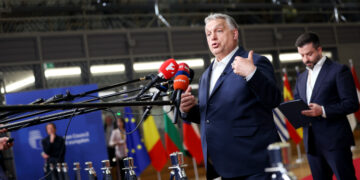





Representing the European Parliament at the informal summit, President Roberta Metsola will address heads of state or government on 24 April.
At their meeting, the heads of state or government are expected to focus on the next EU long-term budget 2028-2034 (Multiannual Financial Framework). Leaders are also set to address the situation in the Middle East and Europe’s response to the subsequent geopolitical and economic fall-out. They will also discuss the ongoing war in Ukraine, and Europe’s ongoing efforts to secure a just and lasting peace, with President Zelenskyy.
Multiannual Financial Framework 2028 – 2034
On April 15, the Budget Committee adopted its draft interim report on the 2028-2034 EU Budget. The Committee is proposing a €1.78 trillion budget (2025 constant prices, €2.01 trillion in current prices) for the seven-year period, representing a nominal increase of €175.11 billion compared with the Commission’s July 2025 proposal (€197.30 billion in current prices). This means that the long-term budget would be set at 1.27% of EU GNI, with debt servicing for the NextGenerationEU recovery fund (0.11% of GNI) over and above the multiannual financial framework (MFF) ceilings.
MEPs want this increase of approximately 10% to be allocated to key EU programmes, with no extra money for administration or decentralised EU agencies. MEPs say their proposal is the minimum amount of money the EU needs to meet its commitments, respond to citizens’ expectations, and address the major challenges it faces.
Plenary will debate the next EU long-term budget on 28 April and vote on its negotiating position on 29 April. Once its position has been adopted, Parliament will be ready to start negotiations with the Council on the regulation setting the structure and main figures for the 2028-2034 budget. Talks can begin once the Council agrees on its common position. Approval of the regulation on the long-term budget requires Parliament’s consent.
On 14 April, the co-rapporteurs of the draft interim report Siegfried Mureşan (EPP, RO) and Carla Tavares (S&D, PT) held a press conference on Parliament’s negotiation position.
Further reading
Vote in the Budget Committee on the EU long-term budget
Press Conference on Parliaments negotiation position
National and Regional Partnership Plans: statements by lead MEPs
The EU’s long-term budget explained
Middle East
On April 15, Parliament’s Foreign Affairs Committee discussed the ongoing events in Iran with Nobel Peace Prize laureate Shirin Ebadi and representatives from Iranian democratic parties and other democracy advocates. MEPs expressed their solidarity with the Iranian people and their concern for their safety. Watch the full debate here.
On 11 March, MEPs debated the US-Israeli military operation against Iran, its consequences, and the need to support Iranians. On the day the first US-Israeli strikes were launched on 28 February, Roberta Metsola said that the “events unfolding in Iran must not lead to a spiral of escalation that could threaten the Middle East, Europe and beyond”.
At the opening of Parliament’s plenary session on 9 March, President Metsola reminded MEPs in a statement of the 47 years of brutal repression the Iranian people have suffered, and of Parliament’s proud history of standing with those people. Condemning Iran’s indiscriminate and desperate attacks on the Gulf States, she said Parliament would “continue to push for people in Iran to live in liberty and to choose their own destiny”.
On 12 February, MEPs adopted a resolution condemning the Iranian regime’s violence against its own people, in particular its targeting of civil society actors, protesters, women, minorities and certain communities. MEPs reaffirmed their solidarity with the Iranian people, underlining that Iranians are the sole legitimate source of sovereignty in Iran. They called on the Council and the Commission to expand targeted sanctions. The resolution is available here.
In a statement issued on 29 January, leading Foreign Affairs committee MEPs welcomed the Council’s confirmation of the designation of Iran’s Islamic Revolutionary Guard Corps (IRGC) as a terrorist organisation. Parliament had been calling for designating the IRGC as a terrorist organisation for a long time. The IRGC is now treated in the same way as other EU-listed terrorist organisations.
Further reading
Debate with Iranian opposition voices
Debate on the situation in the Middle East
David McAllister’s statement on avoiding war in the Middle East
Resolution on the human rights situations in Iran, Türkiye and Uganda
Leading MEPs welcome EU terror listing of Iran’s Revolutionary Guard Corps
Parliament condemns Iran’s brutal repression of protesters
Russia’s war of aggression against Ukraine
On 24 February, Parliament held an extraordinary plenary session, marking four years since Russia’s full-scale invasion of Ukraine. Ukraine’s President Volodymyr Zelenskyy addressed MEPs during the session. Opening the sitting, European Parliament President Roberta Metsola said: “Ukraine’s security is Europe’s security, Ukraine’s freedom is Europe’s freedom, and Ukraine’s future is in Europe.”
In a video message from Kyiv, Zelenskyy expressed gratitude for the European Parliament’s continued support for Ukraine, also pointing out the need for further support from the European Union. He stressed the need for credible security guarantees for Ukraine to prevent Russia from advancing its aggression in Europe. He called for strong sanctions, an end to Europe’s reliance on Russian energy, the shutting out of Russian banks from Europe, a clamp-down on sanctions evasion and Moscow’s shadow fleet, and refused entry to Europe for Russian war criminals.
Also on 24 February, the presidents of the European Parliament, the European Council and the European Commission issued a joint statement on the fourth anniversary of Russia’s illegal invasion of Ukraine. They reiterated that the European Union stands firmly with Ukraine and its citizens and stressed that the EU will continue to provide comprehensive political, financial, economic, humanitarian, military and diplomatic support for Ukraine and its people. The three presidents also highlighted that “the future of a secure and prosperous Ukraine lies in the European Union. Ukraine can count on our full support on its EU accession and on its post-war reconstruction.”
On 11 February, MEPs approved a €90 billion EU loan to Ukraine to address urgent financing needs amid the ongoing war with Russia. Of the loan, €30 billion will be made available for macro-financial assistance or budget support, delivered through the EU’s Ukraine Facility. €60 billion will be allocated to strengthen Ukraine’s defence capabilities and support the procurement of military equipment, ensuring timely access to critical defence products. On Thursday 23 April, Council adopted the last piece of legislation allowing for the loan to be disbursed.
Further reading
Fourth anniversary of Russia’s invasion of Ukraine





Discussion about this post