















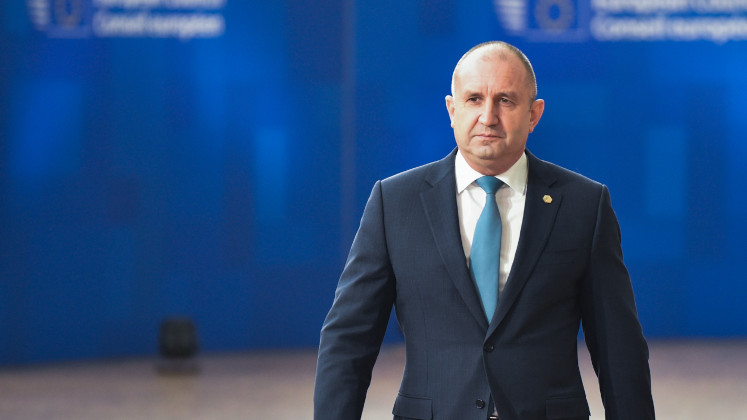
Rumen Radev stepped down as Bulgarian President and led his newly formed Progressive Bulgaria party to victory in the 2026 Bulgarian elections. Teodora Yovcheva and Fernando Casal Bértoa write that Radev’s path to power shows how presidential elections can undermine the stability of party systems.
Bulgaria’s 2026 election, the eighth since 2021, brought a new player into an already unstable party system. Bulgarian President Rumen Radev left office to step into the parliamentary arena, with his newly formed Progressive Bulgaria (PB) coalition winning the election and securing an absolute majority of seats, something unseen since 1997.
The scale of the victory will allow Radev to implement his centre-left policy platform, guaranteeing in principle that no new parliamentary elections will be held until 2030. It also heralds a new era in the country’s ever-changing party system, putting an end – at least for a while – to Bulgaria’s electoral loop.
Radev’s presidency
Although the Bulgarian presidency is relatively weak and intended to be non-partisan, Radev exerted substantial influence over party politics while in office. After first being elected president in 2016, he spent the early years of his presidency opposing the dominant player at the time, Boyko Borisov’s Citizens for European Development of Bulgaria (GERB), whose corruption and state capture he criticised.
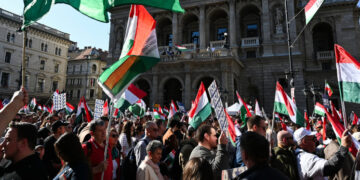
In 2020, a raid on Radev’s presidential premises by prosecutors triggered massive protests in Sofia. Radev then extended his criticism to the Turkish minority party Movement for Rights and Freedoms (DPS) for supporting the Bulgarian oligarch Delyan Peevski. In doing so, he managed to build the image of an implacable fighter against corruption, making him the Bulgarian politician with the highest approval rates.
Boosted by this popularity, Radev lost no opportunity to position himself against Bulgaria’s political parties. He was also accused by Korneliya Ninova, the leader of the party that nominated him (the Bulgarian Socialist Party – BSP), of not only supporting internal opposition within the party against her leadership but also helping to bring down Kiril Petkov’s cabinet in 2022, in which the Socialists had a junior role.
Radev is only the latest in a series of Bulgarian presidents who have tried to exert influence over party politics. One of his predecessors, Georgi Parvanov – president of Bulgaria between 2002 and 2012 – also formed a political party, the Alternative for Bulgarian Revival (AVB), which subsequently participated in government under Borisov.
A decade earlier, Parvanov was the “architect of the triple coalition” between the BSP, DPS and the National Movement for Stability and Progress, which paved the way for GERB’s emergence. Even earlier, in 1992, the first democratic president of Bulgaria, Zhelyu Zhelev, indirectly helped to bring down the first anti-communist government in the country.
Presidential elections and party system instability
These examples show how presidential elections can lead to party system instability and poor democratic functioning. Indeed, research by Fernando Casal Bértoa and Till Weber covering all European democratic party systems since 1848 shows that direct presidential elections lead to the fragmentation of party systems and the weakening of political parties. They also generate instability in partisan interactions, leading to low levels of party system institutionalisation.
There are at least three reasons for this. First, direct presidential elections encourage the formation of new parties by ambitious politicians, either to run in elections or to consolidate presidential power. This tends to increase electoral fragmentation and make party interactions such as coalition formation more difficult.
Second, direct presidential elections encourage politicians to use existing political parties to get elected or to treat their own parties as empty vessels. This can produce higher party turnover and reduce the stability of relationships between parties.
Finally, direct presidential elections force presidents to pay back the electoral support they have received. This often results in presidents backing volatile and sometimes contradictory governing majorities. This changes pre-existing patterns of party competition and increases volatility.
Bulgaria is a case in point. The Bulgarian party system after the transition to democracy in 1990 was initially a bipolar confrontation between the post-communist and anti-communist blocs.
In 2001, this shifted to a multipolar structure in which socialists, liberals, conservatives, populists and nationalists have struggled to form stable governments. It is for this reason that Bulgaria has been held “in an electoral doom loop” with eight different parliamentary elections within the last five years.
The perils of presidentialism
Another study of Asian democracies finds similar effects from direct presidential elections. In this case, three Asian democracies (Indonesia, Taiwan and Sri Lanka) that introduced direct presidential elections experienced an immediate decline in party system stability, which never again returned to the level seen during the period when their head of state was appointed on a hereditary basis.
One interesting feature of both European and Asian examples is that the detrimental impact of presidential elections on party system stability occurs even if, as in Radev’s case, the president does not have strong powers. Yet powerful presidents can hinder the stabilisation of party politics even further.
In some cases, presidents have increased fragmentation by forming completely new political parties, such as Volodymyr Zelensky’s Servant of the People in Ukraine. In other cases, presidents such as Paul von Hindenburg or Boris Yeltsin have adopted a stance of being “above” or “against” political parties and thereby undermined party institutionalisation. Others have fostered new governing coalitions that change the way parties interact, which occurred after the 2005 presidential elections in Poland and Emmanuel Macron’s victory in France in 2017.
The potentially negative impact of direct presidential elections has been evident ever since Louis-Napoléon Bonaparte, the future Napoleon III, was popularly elected in France in 1848. Bulgaria is just the latest example of what the famous Spanish political scientist Juan Linz once called “the perils of presidentialism”.
Note: This article gives the views of the authors, not the position of LSE European Politics or the London School of Economics.
Image credit: European Union.




Discussion about this post