
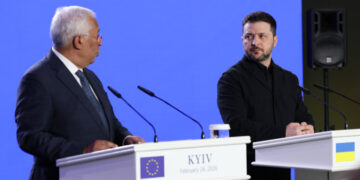











Is war fatigue reducing Europe’s support for Ukraine? Adam Holesch and Benjamin Martill argue that despite growing pressures, Europe’s consensus on Ukraine has proven to be remarkably durable.
When Russia launched its full-scale invasion of Ukraine in February 2022, Europe responded with a sense of unity rarely seen in European politics. Governments imposed sanctions on Moscow, integrated millions of Ukrainian refugees, and sent military aid to Kyiv. Across the continent, most citizens rallied behind the Ukrainian cause and political leaders largely agreed on the need to resist Russian aggression.
Four years later, the question facing Europe is no longer whether it supports Ukraine, but whether that support can endure. The war has become a test not only of Ukraine’s resilience but also of Europe’s political stamina. Rising costs, competing global crises and shifting geopolitical dynamics have introduced strains that were absent in the early months of the conflict.
Yet the European response has proved far more resilient than many expected. War fatigue may exist, but it has only cracked – not broken – the political consensus behind Ukraine.
The shock that unified Europe
Russia’s invasion marked a turning point for European politics. For decades, the European Union had operated primarily as an economic and regulatory power. Many member states continued to profess military neutrality, while others preferred more civilian pathways to achieving security. Almost overnight, the EU found itself confronting a major war on its doorstep – one that profoundly challenged existing ways of doing things.
The immediate response was strikingly unified. European governments condemned the invasion, coordinated sanctions against Russia and began delivering unprecedented military assistance to Ukraine. The EU adopted new security initiatives, launched training missions for Ukrainian soldiers and even granted Ukraine candidate status for EU membership.
Political parties across the ideological spectrum closed ranks. Mainstream parties on the left and right largely agreed on the need to support Ukraine. Even some of the parties that had previously maintained sympathetic attitudes toward Moscow softened their positions or went quiet on security issues, recognising the political risks of appearing pro-Russian.
Public opinion followed suit. Polls across Europe in 2022 showed overwhelming support for humanitarian assistance, refugee protection and sanctions against Russia. Even military aid, traditionally controversial in many European countries, received majority backing.
This unity reflected a dynamic known as the “rally around the flag” effect, where citizens rally behind their governments in times of international crisis, while opposition parties often restrain criticism to present a united front.
Why maintaining support is hard
But sustaining a wartime support coalition, especially one spread across multiple countries, is never easy. Governments supporting Ukraine face a delicate balancing act. They must maintain support both domestically and among international partners. Any fracture in this coalition could weaken the broader effort by increasing costs for other members, incentivising further defection or lowering collective morale.
Several factors determine whether public support can endure. The first is the cost. Military assistance requires significant financial resources, and sanctions on Russia have come to have difficult economic consequences for European economies – particularly in the form of higher energy prices.
The second is the duration of the war. Conflicts that drag on for years tend to erode public enthusiasm, especially when victory appears uncertain. Over time, new crises can displace earlier ones from the public agenda.
The third is the perceived effectiveness of the effort. Citizens are more willing to accept costs if they believe those sacrifices are producing results. Where the prospects of victory become less clear, rising costs can significantly undermine the public’s willingness to “throw good money after bad”. Together, these pressures can create war fatigue, a gradual decline in support for continuing the effort.
Signs of war fatigue
Four years into the conflict, signs of war fatigue have begun to appear across Europe. Russia’s strategy has played a role in this shift. By restricting energy supplies and driving up fuel prices, Moscow sought to create economic pain in Europe and weaken public support for Ukraine. The resulting energy crisis in 2022 pushed inflation in some European countries above 20 percent.
At the same time, the battlefield situation has become more uncertain. Early Ukrainian successes generated optimism that the war might be won quickly. But as the conflict settled into a grinding stalemate, doubts began to emerge about whether western support could decisively change the outcome.
Other global crises have also diverted attention. The war in Gaza and the recent attack on Iran shifted media coverage and political focus away from Ukraine. European governments suddenly faced competing demands on their diplomatic and military resources.
Public opinion surveys reflect these pressures. Many Europeans have grown more pessimistic about Ukraine’s chances of winning the war. In countries hosting large numbers of Ukrainian refugees, initial enthusiasm has occasionally given way to concerns about economic burdens.
When fatigue becomes politics
An important question is whether – and how – evidence of war fatigue translates into political conflict. Yet, across Europe, the degree of politicisation has varied widely.
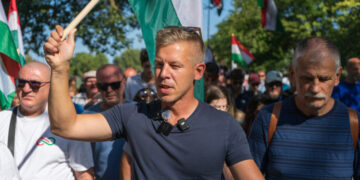
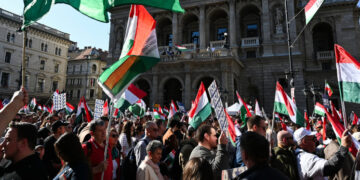
In some countries, Ukraine has become a contested political issue. In Slovakia and the Czech Republic, the most recent elections have brought governments more sceptical of sanctions against Russia. In Poland, political parties have debated issues such as Ukrainian agricultural imports and refugee policies and the far-right Konfederacja has politicised the issue. Viktor Orbán made support for Ukraine an important part of his unsuccessful 2026 electoral campaign.
Elsewhere, however, consensus has largely held. In the United Kingdom, both major parties have continued to support Ukraine regardless of changes in government, while Reform has been notably quiet on the issue.
Italy’s right-wing government under Giorgia Meloni has maintained its pro-Ukrainian stance despite earlier scepticism from some coalition partners. In Finland and Sweden, two countries that abandoned decades of neutrality to join NATO after the invasion, political leaders have deliberately cultivated cross-party consensus to prevent the issue from becoming divisive.
Even within the European Parliament, where populist parties gained seats in recent elections, far-right parties remain divided over how aggressively to confront Russia.
There are parties in the 10th Parliament that vote in a way that is nearly 100% aligned with Russia’s interests, such as Hungary’s Fidesz, Germany’s AfD, Austria’s Freedom Party and the Italian Lega and Belgian Flemish Interest. Others, such as the Sweden Democrats, Poland’s Law and Justice and the Finish True Finns are much more assertive against Russia.
The Trump factor
One of the most dramatic shifts affecting European politics did not originate in Europe. The re-election of Donald Trump as US President in 2024 fundamentally altered the strategic environment.
Trump has repeatedly questioned US support for Ukraine and demanded that European allies dramatically increase their defence spending. His administration has also signalled openness to pressuring Ukraine into making territorial concessions to Russia. Trump’s recent attacks on Iran have spiralled into a complex regional war that has served to equally unite and divide Europeans in equal measure and has led to US sanctions on Russia being eased to reduce pressure on oil prices.
For European leaders, Trump’s return and his subsequent foreign policy adventurism has underscored a longstanding vulnerability: Europe’s reliance on the United States for security. As Washington reduces its commitment to Ukraine, European governments face the challenge of sustaining support largely on their own.
Paradoxically, Trump’s stance may strengthen European unity rather than weaken it. The prospect of diminished American leadership has revived debates about European strategic autonomy and greater defence integration.
The long test ahead
Despite growing pressures, the most striking trend across Europe is how durable the political consensus on Ukraine has been. Mainstream political parties across the continent continue to support Ukraine’s defence. Even where populist parties criticise aspects of the policy, they often soften their positions once they enter government and confront the responsibilities of office.
In many ways, support for Ukraine has become a new political boundary in European politics, a red line that mainstream parties are reluctant to cross. The reasons are both moral and strategic. For many Europeans, the war represents a struggle over fundamental values such as democracy, sovereignty and the rule of law. At the same time, allowing Russia to succeed could embolden further aggression and undermine Europe’s security.
Yet the real test lies ahead.The war in Ukraine is unlikely to end soon. And the longer it continues, the more difficult it will become to sustain the political unity that characterised Europe’s initial response. War fatigue will almost certainly continue to grow. Economic pressures, shifting geopolitical priorities and electoral politics will continue to test European resolve.
But the experience of the past three years suggests something equally important: European support systems have proven more resilient than many expected. Aid for Ukraine has not collapsed under the weight of economic costs. Nor has it fractured along predictable ideological lines.
Instead, Europe has demonstrated a surprising capacity to sustain a costly foreign policy commitment in defence of both strategic interests and democratic values. Whether that resilience can endure through the next phase of the war remains one of the defining questions for Europe’s political future.
Note: This article gives the views of the authors, not the position of LSE European Politics or the London School of Economics.
Image credit: European Union.




Discussion about this post