




















The success of Péter Magyar and his Tisza party over Viktor Orbán in Hungary’s election has been portrayed as a victory for liberal democracy over populism. Yet as Benjamin De Cleen argues, Magyar’s triumph over Fidesz was driven by its own form of democratic populism.
Viktor Orbán’s defeat by Péter Magyar and his Tisza party in the Hungarian elections has been hailed by many as a victory for liberal democracy over populism. But what if populism is not the key to understanding Orbán and is instead the key to understanding his defeat?
There are two problems with the Magyar-defeats-populism narrative. First, is it really populism that has been dealt a blow here? Much of the commentary on the election uses the term populism as shorthand for illiberalism, authoritarianism and the far right. But if we define populism more precisely as a form of politics that revolves around the opposition between “the people” and “the elite” – the dominant academic viewpoint – it becomes clear that populism has long since become a rather minor feature of Orbán’s politics.
The 2026 campaign revolved around Orbàn as the “safe choice”, the experienced leader who would protect Hungary from the EU, Ukrainian interference and from war with Russia, as well as from all kinds of nightmare scenarios associated with Magyar.
Fidesz did wage a strongly polarising campaign, as it always did. But polarisation is not enough to speak of populism. With Fidesz so clearly identified with power and so obviously having become an oligarchy, it could no longer successfully claim to represent “ordinary people” against “the elite”.
Second, what is missing from much of the commentary is the populist dimension of Magyar’s victory. Many attribute Magyar’s win to “the construction of a broad, diverse, and patriotic grassroots social movement” against Orbán. But, driven by a view of populism as inherently dangerous to democracy, what they fail to acknowledge is that this kind of construction of a broad coalition of people against a corrupt elite is exactly what populism looks like.
The people versus Orbán
The political theorist Ernesto Laclau wrote that populism is not an ideology, but a political logic that links a diverse range of “unsatisfied demands” in a “chain of equivalence”. What allows populists to construct such a chain between diverse demands and social groups is shared opposition to an elite. This is what happened in Hungary.
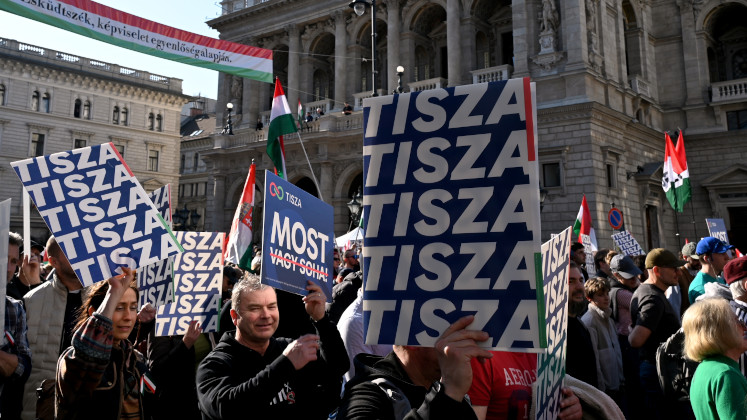
The massive Tisza win cannot be understood through a traditional left-right ideological lens. Instead, Magyar’s victory was the result of the construction of a populist down/up opposition between “the people” and “the elite”, between ordinary Hungarians and the Fidesz regime, that cut across left and right and appealed to a very wide electorate.
Interestingly, among Hungarian analysts and other scholars with a deeper understanding of Hungary, Magyar’s populism is more commonly recognised than in international commentary. For example, Emilia Palonen calls Tisza “a populist, counter-hegemonic alliance against Fidesz”. István Benedek writes that Magyar managed to “redefine the axis of political conflict” and “highlighted national unity over ideological antagonism by targeting the narrow ruling elite”.
This narrow elite was opposed to a very broadly defined Hungarian people that cut across ideological cleavages and also appealed to Fidesz voters, with Magyar speaking of a “new homeland… where it no longer matters whether someone is conservative or liberal, religious or atheist, with a family or single, poor or wealthy, but only that we are all Hungarians and we love our country”.
This populist antagonism between a broad “people” and Orbán explains why Magyar, who defected from Fidesz in 2025 and has a centre-right profile, managed to attract such an ideologically diverse voter base. Hundreds of thousands of left-wing and progressive voters, for example, knew that Magyar is much more right-wing than they are. They still voted for him because they believed that, finally, here was someone who could bring down Orbán and put Hungary back on the path to democracy and the rule of law.
A democratic populism
The dominant anti-populist view treats populism as a polarising and emotional type of politics that is a threat to the moderation, pluralism, expertise and rationality needed for democratic politics.
Orbán fits that picture perfectly. Magyar does not, with his campaign revolving around anti-corruption, democracy, the rule of law and decent public services. Many commentators applaud Magyar’s victory over the “populist” Orbán, but their anti-populism prevents them from seeing that this victory was itself an example of populism.
The Tisza landslide was the result of exactly the kind of emotionally charged antagonism that anti-populists dislike. Magyar constructed a Hungarian “people” made up of a wide variety of groups and offered them the choice between Tisza and the corrupt Fidesz regime. Left-wing and progressive parties either did not participate in the elections or scored extremely poorly.
Everyone understood that now was the time to unseat Orbán, and that voting for Tisza was the only way of getting this done. In Hungary, with its deeply entrenched Fidesz regime and its exceedingly majoritarian electoral system, populism was probably the only strategy with a chance of success.
This populism inevitably came with strong emotions. Magyar himself has a certain charismatic appeal, but what is at least as important is that – in a typically populist manner – he became the vehicle for the pent-up frustrations and anger of 16 years of Fidesz rule.
He urged Hungarians to not be afraid of Fidesz and to dare to believe in the fall of Orbán. He managed to turn around the political depression of many Hungarians and became the symbol of realistic hope. He managed to reclaim Hungarian symbols from their association with Fidesz, urging Hungarians to reclaim their country in the name of patriotism.
Disproving the view that populism is inherently undemocratic, Magyar’s win shows that sometimes a desire for democracy and rule of law is exactly what drives a populist movement, and that sometimes populism is exactly what democracy needs.
Hungary’s post-populist moment?
It remains to be seen what will happen to populism in Hungary. To some, such as Yascha Mounk, Orbán’s electoral defeat signals that Hungary has entered its “post-populist” period. This might be true if we see populism as a synonym for autocratic backsliding or the far right. But it is not true if we treat populism as a political logic of bringing together a diverse movement in opposition to an elite.
For one, it is unclear what will happen to Fidesz. The Fidesz oligarchy still controls many levers of power. Fidesz or whatever comes out of it are likely to try to make Magyar’s life very difficult. Perhaps it will turn to a populist strategy in doing so, even though it will take some effort to shake the corrupt oligarchy label.
Second, Tisza’s win was not post-populism but rather peak populism. It was arguably the most populist moment Hungary has lived through since the fall of communism. This anti-Fidesz energy will probably be sustained for a while, but such a broad coalition cannot be sustained forever. Cracks are already showing and will only grow.
The notion of post-populism might in fact help us to analyse what happens next. Once Tisza’s populist moment fades, the populist antagonism between ordinary Hungarians and the Fidesz elite will likely give way to frustrations with the Tisza government, ideological disagreements within the Tisza camp and the reappearance of older opposition parties and new political forces.
The shape of things to come will also depend on what happens to the strongly majoritarian electoral system that kept Fidesz in power and gave Tisza its constitutional majority. But whatever happens, we should remember that Hungarians have regained a space for democratic politics not because they defeated populism, but rather through a form of populism that enabled them to oust their corrupt elite.
Note: This article gives the views of the author, not the position of LSE European Politics or the London School of Economics.
Image credit: Blue Corner Studio provided by Shutterstock.








Discussion about this post